Seriously. National Prohibition was the culmination of some eighty years of state and local prohibitions. Its “failure” discredited alcohol prohibition so badly that almost all states discarded it quickly. Countywide prohibition still exists in some of the Deep South (though not in any major cities, as far as I know), and many small townships are still dry, but drinkers today are rarely unable to obtain a legal drink, and that’s been the case for decades.
A few years before Prohibition went into effect under the Eighteenth Amendment in 1920, about 32 states had gone dry and 15 had “local option” prohibition (which was basically a way to encourage and hasten county-level prohibitions). The local option movement in particular had been very successful; about two-thirds of the states had local option by 1913. (After 1913 about half of the local option states went all in for state prohibition, likely in connection with the Anti-Saloon League’s drive for national prohibition. But even before that big drive, there were about 10 dry states and 30 local option states in 1910.) Few of the state prohibitions imposed in the forty years before Prohibition were repealed — that is, not until national Prohibition was repealed. It’s entirely possible that many of those states would have stayed dry for a long, long time, maybe even to this day, if the prohibitionists had quit while they were ahead instead of trying to impose prohibition everywhere.
Yet nearly all of those historically dry states gave up the ghost on prohibition shortly after national Repeal in 1933. Only a handful of states, if I recall correctly, kept their statewide bans through 1940. The last holdout was Mississippi in 1966. My point — and I do have one! — is that the apparent abject failure of national Prohibition probably discouraged many temperance-minded politicians and electorates from holding onto prohibition at the state or local level.
Are you saying Prohibition wasn’t an abject failure? You’re not saying it was a success, are you? No, but it was a qualified failure, not a complete failure. (This is the general consensus among historians, by the way. Jack S. Blocker, Jr.’s article “Did Prohibition Really Work?” is a good place to go for the details.) Alcohol consumption did fall during Prohibition; according to careful estimates by economists Jeffrey Miron and Jeffrey Zwiebel, who are anything but pro-Prohibition, alcohol consumption fell about 70% early on and regained only about half of that decline in later years. Prohibition seemed to work well enough in rural areas, small towns, socially conservative areas, and generally where there was widespread support for it. Which was a lot of the nation, especially acreage-wise. (This is kind of like those red-vs-blue county-level maps of support for Republicans vs. Democrats in presidential elections.) Prohibition failed in the cities, where drinking was more popular than temperance. It failed spectacularly in New York City and Chicago, the nation’s two largest cities at the time. Press coverage of speakeasies, flappers, Al Capone, and general flouting of Prohibition in the nation’s two largest media markets would tend to give a skewed impression of how Prohibition was faring nationally. “Prohibition was a failure” became such strong conventional wisdom that virtually nobody thinks of bringing it back. Even some of those few dry holdout towns, like the ones I’ve working on a paper on (Kensington, Takoma Park, and Damascus, Maryland), have jumped on the wet wagon.
We can also thank Prohibition for the death of the old all-male saloon, which gave way to the fuller inclusion of women in our drinking places and rituals. (See Catherine Gilbert Murdock’s excellent book “Domesticating Drink” for a fuller account.) Prohibition spawned countless new cocktails, as spirits, being much more easily concealed than beer, soared to new heights of popularity. While Prohibition’s unintended legacy isn’t all positive — for example, it made American beer even blander and more homogenous (I have a paper on this that I can send you) — the perception that it failed outright arguably means that the overwhelming majority of American drinkers can get a drink wherever they want. Speaking of which . . .
April 7 occupies a special place in American beer history. Despite the title of the post, it’s a good place.
On April 7, 1933, after thirteen years of Prohibition, Americans could legally drink beer again. Thus, National Beer Day. But there was a catch.
Prohibition wasn’t over. The 18th Amendment, which gave us national prohibition, would not be repealed until December 5. Although Congress had already voted for the repeal amendment on February 20, that amendment still needed the approval of three-fourths of the states to become law. That approval happened in record time, by December 5, but that’s still eight months later than April 7. So what happened on April 7?
April 7 was the date designated by Congress for legal sales of “non-intoxicating” beer and wine, in a law passed on March 22, as the states began the process of ratifying the repeal amendment. (The first state to do so was Michigan on April 10, so Michiganders get yet another day of celebration.) The law was called the Beer-Wine Revenue Act (or the Cullen-Harrison Act, for its sponsors). It basically said that alcoholic beverages that were 3.2% alcohol (by weight, that is, which equates to 4% by volume, or ABV) were not intoxicating. That mattered because the Prohibition amendment had outlawed the manufacture, distribution, and sale of intoxicating liquors, without specifying a threshold for “intoxicating.” The enforcement act for Prohibition, the Volstead Act, defined intoxicating as anything over 0.5% alcohol by weight. So the Cullen-Harrison Act simply changed the definition of “intoxicating.”
Now, generations of college students could tell you that “3.2 beer” can be plenty intoxicating, as long as you drink enough of it, but that’s beside the point. The point is that Americans were thirsty for beer, as Prohibition didn’t do much to hurt wine and spirits consumption but seems to have had a devastating impact on the beer market. “3.2 beer,” or 4% ABV beer, is some weak tea, as most mainstream beers today are 4.5-5.0% ABV and most craft beers are 6.0% or (often much) higher, but people took what they could get.
So if you want to do National Beer Day right, find yourself a beer that’s 4% ABV or less. And good luck with that — even Mich Ultra is 4.2%. I’m celebrating with a 7 oz. Miller High Life “pony” (4.5%), which is the lowest ABV I could find.
PS For full-strength beer, December 5 — Repeal Day — is your day. By the way, I’m intrigued by the claim of the F.X. Matt brewery in Utica, which makes Utica Club beer, that Utica Club was the first beer served after Prohibition, on December 5. Seems unlikely, as other breweries had been at it for eight months and probably had some full-strength beers ready to go at the stroke of midnight on December 5. But I’d love for someone at the brewery to try to convince me.
Unemployment at 4.9%. More than 75 straight months of continuous job growth. Per capita GDP at an all-time high. Summer’s here. But nobody’s dancing in the streets.
Here are a couple graphs that may help explain why:
First, note that even as real per capita GDP continues to reach new peaks, the typical American adult (i.e., the person at the 50th percentile) in 2014 was no better off than in the last two recessions. Median personal income was down about 5% from about a decade ago. The rising tide is clearly not lifting all boats. The more politicians crow about the improving economy and the more economists say we are at “full employment,” the greater the disconnect becomes.
Caveat: Ideally I’d have median personal income data from after 2014. The numbers have likely improved since then. Jared Bernstein notes that real weekly earnings have grown almost 4% since 2014. Whether personal income has had similar growth also depends on employment trends. Which brings me to:
The above is the US “prime-age” (25-54) employment/population ratio from 1990 to present. The employment/population ratio is about 2 points lower now than then, partly because the standard unemployment rate is about 1 point higher and also because more jobless people are “out of the labor force,” i.e., not actively seeking work. Would they take work if offered it? The Bureau of Labor Statistics report for June suggests many of them would — the alternative unemployment rate including jobless “discouraged workers” and “persons marginally attached to the labor force” is 6.0%. (Add in part-time workers who’d prefer to be full-time and the rate rises to 9.6%. It’s been improving for six years but is still no better than in mid 2008 when we were in a recession.)
What’s really striking to me, and what inspired the title, is the gender breakdown of those prime-age employment/population numbers. (Sorry, the separate BLS graphs for men and women are too messy to use here, but you can Google them.) For women, the employment/population ratio has regained its 1990 level of 71%; for men, the ratio is down about 5 points, to 85%. There’s a story here, probably several. The erosion of male privilege has been a big theme of this year’s political commentary. Without getting into the politics or ethics of that, let’s just note:
These graphs indicate that it by no means a new thing, at least in the labor market. The male employment/population ratio has been falling since 1969, when it was 95%. The female employment ratio has been rising steadily since at least the late 1940s, when it was less than half the current level.
During the boom decade of the 1990s, the male employment/population ratio fell by about half a point, while the female ratio rose sharply, from 71% to 74.5%.
Male employment was hit harder than female employment during the 2008-2009 recession (men’s employment fell from 89% to 81%, women’s from 74.5% to 69%).
Men’s employment has actually risen faster than women’s during the post-2009 recovery (ratio up by about 4 points vs. 2 points), but again, the male employment ratio is down about 5 points from 1990, whereas the female employment ratio is unchanged.
This new article of mine in Business History has nothing to do with the economic and financial crisis, but it’s gotten more press than any previous article I’d written, so I thought I’d post a link here.
The link will take you to the abstract and the first page only. If you would prefer to read the full, 31-page version, then here is the deluxe link. (If for some reason it does not work, you can email me — ranjit dot dighe at oswego dot edu.)
The article in brief: This article examines the historical origins of bland American beer. The US was not strongly associated with a particular beer type until German immigrants popularized lager beer. Lager, refreshing and mildly intoxicating, met the demands of America’s growing working class. Over time, American lager became lighter and blander. By the 1880s, there was a distinct “American adjunct lager” that used rice or corn to minimize the bitterness and heartiness of the malt and hops. For the next century it would get blander still and would extend its dominance of the beer market. Why? This article emphasizes America’s uncommonly strong temperance movement, which put the industry on the defensive. Another factor was the American labor market in the late 19th and early 20th centuries, with long hours (and meals often consumed at saloons between shifts), negligible union protections, and a substantial “reserve army of unemployed” from which a tipsy worker could easily be replaced. Even before Prohibition, pale pilsners were some 85-90% of the market. (And yes, Prohibition was really bad for hearty beers.) Brewers consistently pushed their product as “the beverage of moderation,” and consumers increasingly sought out light, relatively non-intoxicating beers. The recent “craft beer revolution” is explained as a backlash aided by a changing consumer culture and improved information technology. The paper’s derives its conclusions from data on beer styles, production, and content (alcohol, hops, and malt), as well as articles and editorials in trade publications.
The latest currency news is that Treasury Secretary Jack Lew is going to put a woman’s face on US currency for the first time. That is good news, of course, and way overdue. But the devil is in the details, and so far the details are not good. I say this as a believer in women’s equality and in modern economics.
First, the bill in question is the ten-dollar bill. Why the tenner? Of the four bills we use regularly — the one, five, ten, and twenty — this is the most redundant and the one we see the least of. You need those ones and fives to make change and pay for drinks, and twenties are what come out of the ATM. If you didn’t see a ten spot for a whole month, would you even notice? So it reeks a bit of tokenism to put a woman on our least important of the top four bills. The names that have been mentioned are fine — Harriet Tubman, Eleanor Roosevelt, Sojourner Truth, etc. — but Lew’s suggestion that there might be multiple ten dollar bills, with different women’s faces, seems to compound the tokenism. There’s not one woman in US history who’s important enough to warrant her own bill?
The other big problem is that the current occupant of the ten-dollar bill is the perhaps the most deserving American of a spot on our currency: Alexander Hamilton. As one of the authors of The Federalist and then as the first Treasury Secretary, Hamilton consistently advocated for the building blocks of a modern, functioning economy, as opposed to the feudal system of slave agriculture that dominated the South or the “nation of small farmers” that Thomas Jefferson idealized (despite being a rather large slaveholding farmer himself). Hamilton’s was a lonely position at a time when about 90% of the American population lived in rural areas and was engaged in farming. And Jefferson, then as now, was the more popular, inspirational, romantic figure of the two. But Hamilton eventually prevailed, as the nation industrialized and adopted a modern system of banking, including two central banks which finally eventually evolved into the Federal Reserve System in 1913. When a central bank does its job properly, recessions, deflation, and financial panics are less severe. Their track record is far from perfect, to be sure, but that’s a debate for another thread. Jefferson opposed a central bank, as did his fellow Founding Virginian and successor, James Madison, who had the bad timing to let its lease expire just before the War of 1812, when the nation could have really used a central bank. Madison relented after the war and Congress chartered a new central bank, but its lease was allowed to expire in another bit of ill timing, just before the Panic of 1837. Read the rest of this entry »
See for yourself. Our anemic economic performance since 2007 is . . . the best in the world?
Yes, it’s still a slow recovery that has yet to restore full employment, but, except for Germany, we’ve done better than any of our counterparts in Europe that also experienced a financial crisis.
“The ordinary will be considered extraordinary.”
I was going to say something about the folly of austerity policies (spending cuts and tax increases) during an economic slump, which is true insofar as US budget policy has been only mildly contractionary while our European counterparts have embraced austerity and all but one have sick economies to show for it, but that one is Germany, which was slightly ahead of the US as of 2013:Q2 (data for 2013:Q3 and Q4 were not available for the European countries). Germany’s economy defies easy explanation. Maybe Germany should be Luke Wilson’s character and the US can be Maya Rudolph’s.
(For anyone who’s not familiar with “Idiocracy,” here’s the trailer.)
The essence of the argument is that the expected benefits of legalization far exceed the expected costs, so it’s worth doing. The benefits and costs have little do with what people normally think of as economic factors, like tax revenues and law enforcement expenditures, which are actually quite small. What matters much more is the human cost of arresting, imprisoning, and/or seizing the assets of thousands of people and putting some 20 – 30 million more of them at risk of similar punishment for their recreational behavior.
Yesterday 1.3 million jobless Americans lost their unemployment benefits, thanks to Congress’s unwillingness or inability to extend long-term unemployment insurance funding. The number could rise to 4.9 million within the next year.
Extending the unemployment benefits is a no-brainer at a time when long-term unemployment rates are still higher than in any previous postwar recession, when there are three unemployed people for every job vacancy, and the money paid out in unemployment benefits quickly gets spent, thereby boosting the still-weak economy. Support for the extension is strong among the public, liberal public policy groups, and even some prominent conservatives. But Congressional Republicans continue to block it.
I’ve heard four arguments against extending unemployment benefits beyond the current 26-week threshold.
1. It encourages idleness.
Econ 101 does indeed tell us that, other things equal, anything you do to make people’s unemployment experience more pleasant, like giving them cash, reduces their incentive to take a job. Which is which unemployment benefits normally expire after 26 weeks. But these are not normal times, not with the long-term unemployment rate at 2.6%, a higher level than in any previous recession or recovery since WW2. Yet in all of those other recessions, whenever long-term unemployment got anywhere near this high, unemployment benefits were extended. If you cut off long-term unemployment benefits, some of the long-term jobless would find jobs, but the vast majority would not, unless a million or so vacancies could somehow materialize too and employers suddenly developed a preference for long-time jobless applicants. (Currently employers have a strong preference for applicants who are not unemployed, followed by those who have only been out of work for a short spell.)
A recent empirical study published by the Brookings Institution estimates that in the absence of extended unemployment benefits the unemployment rate would be about 0.1 – 0.5% lower, which we will note that is a small fraction of the current 2.6% long-term jobless rate. And the author notes that about half of that improvement would come not from the long-term unemployed rejoining the work force but from currently employed people sticking with their jobs because of the worsening of the alternative. So the estimate becomes just 0.05% – 0.25% of the long-term jobless who would rejoin the work force if benefits were cut off. Do the math, and the estimated ratio of still-unemployed people without benefits to newly re-employed is in the range of 9-to-1 to 51-to-1. Rather high pain-to-gain ratios.
2. It hurts the long-term unemployed by lengthening their term of unemployment even further, making it even harder for them to find a job.
While it’s true that employers are reluctant to hire the long-term unemployed, this argument makes the same false assumption as in (1.), namely that the jobs are out there and the long-term unemployed just aren’t looking hard enough or aren’t willing to take them. A 3-to-1 unemployed-to-vacancies ratio should give the lie to that. And the ratio of long-term unemployed to vacancies that long-term unemployed people have a realistic shot at is surely much higher.
3. It’s no longer needed, what with the economy’s recent improvement. Real GDP grew 4.1% in the last quarter, and the unemployment rate is down to 7%.
Those numbers have dominated the recent headlines, but they’re irrelevant here. Thanks to growing productivity, real GDP is now higher than it was before the recession, but with two million fewer workers. And as I seem to write in every post, the standard unemployment rate is largely irrelevant, when millions of jobless Americans have given up looking for work, millions more have left or avoided the labor force entirely, and other millions are involuntarily working part-time because they can’t find full-time work. More relevant numbers are the 13.2% comprehensive (U-6) unemployment rate; the 58.6% employment/population ratio, which has not improved since the depth of the recession; and, of course, the 2.6% rate of long-term (27+ weeks) unemployment as a percentage of the labor force. The economy’s recent good news has largely bypassed the long-term unemployed. The best that can be said about the long-term unemployment rate is that it’s been coming down, from about 4.3% four years ago, but even then it’s still as high as at any point since the 1940s.
4. It costs money.
This is the silliest objection of all, since the amount in question ($24 billion next year) is not only less than 0.7% of the budget, but a lot of the money would be returned to the federal, state, and local government in the form of tax revenues as the unemployed spend that income. Unemployed people can be counted on to spend nearly all of their benefits, especially seeing as the benefits are small compared to their previous income; the benefits level varies by state, with most states in the range of 25-45%. While unemployment benefits cost money, so do food, clothing, shelter, utilities, and all the other necessities and commitments that people have. They’re called benefits because they provide very tangible benefits to the people who receive them, far in excess of their cost to the taxpayers. (And it should be noted that the unemployed already paid into the system when they were working and will do so again if and when they return to work.)
Whatever your opinion on this issue, there should be no doubting that long-term unemployment is one of the central problems of our time. The long-term unemployed are almost 40% of the total unemployed, which is roughly twice as high as in any previous postwar recession (see graph).
While extended unemployment benefits do more good than harm, what we need even more are jobs. Government job creation is a non-starter in Congress and apparently with the public as well, so once again we are left with the Micawber-like hope that something will turn up in the private sector.
Special no-prize to the first person who can connect that last line to this video of Keith Richards:
Six years ago this month, the US economy officially peaked. We didn’t know it till a year later when NBER made the call, but the labor market has never been the same. The unemployment rate crept upward through the summer of 2008, before exploding that fall and reaching double digits the next fall (up from 4.5% in the first half of 2007), several months after the recession officially ended in June 2009. People call that devastating eighteen months the Great Recession, but I prefer to call this whole six years (and counting) the Little Depression because the economy — and the labor market in particular — remains so depressed.
Consider the change from December 2007 to now (or rather to November 2013, the most recent month we have data for):
The adult (age 16+ population) grew by 13,411,000.
Employment shrunk by 1,887,000.
Unemployment rose by 3,262,000.
“Not in labor force” (neither employed nor actively looking for a job) rose by 12,035,000.*
(*And no, most of that does not come from old people retiring. The drop in the employment/population ratio is 4.1 percentage points if you include all of the adult population, and 3.8 percentage points if you include only those in the 25-54 age range.)
Sometimes the numbers really do speak for themselves.
Wednesday the Federal Open Market Committee did the expected, by announcing a “tapering” off of its $85 billion monthly purchases of long-term Treasury bonds and mortgage-backed securities (MBS’s), citing “the cumulative progress toward maximum employment.” Thursday the BLS announced that weekly jobless claims rose to their highest level in nine months. Ouch.
Granted, the spike in jobless claims might not mean much, as they can be volatile, especially around holiday time, and indeed the four-week average of jobless claims “only” rose to its highest level in one month. Even so, the “progress toward maximum employment” has been glacial, if it can be called progress at all. The media have trumpeted the good news in the Bureau of Labor Statistics’ (BLS) latest employment report, which found that the standard unemployment rate fell from 7.3% to 7.0%, its lowest level in five years, and employers added 203,000 jobs. That’s fine, but it’s also just one month. Let’s look at the past year, from Nov 2012 to Nov 2013, using the Households Survey numbers in the employment report.
In the past year the adult US population grew by almost 2.4 million. The number of people “Not in labor force” (neither employed nor actively looking for a job) also grew by slightly more than 2.4 million. The total US labor force actually fell by 25,000, and the employment-to-population ratio also fell slightly, from 58.7% to 58.6%. While it’s good news that total employment rose by 1.1 million and unemployment (and people who say they currently want a job) fell by 1.1. million, the biggest growth sector by far is “Not in labor force,” again with 2.4 million. The employment/population ratio is exactly the same now as it was four years ago, in Nov 2009. This is not progress.
I wouldn’t be an economist if I never said “On the other hand,” however, and on that hand we have the “Establishments Survey” that furnishes the other half of the BLS report. The unemployment and employment/population rates come from the Households Survey; the payroll numbers (e.g., 203,000 jobs added) come from the Establishments Survey. Average monthly payroll growth for the past year was 191,000 jobs, or more than double the puny job growth in the Households Survey (1.1 million / 12 months = 92,000 jobs per month).
What would victory look like on the jobs front? I would say 5% unemployment, which the economy had for 35 straight months in the mid-2000s, or less. (And I would want the reduction to come from job growth and not from people leaving the labor force.) How far are we from 5% unemployment? The Atlanta Fed’s handy jobs calculator has the answer. If the economy keeps on adding 191,000 jobs per month, we return to 5% unemployment in three years. If it adds just 92,000 jobs per month, we never get back to 5% unemployment, unless the labor force does a whole lot of shrinking. If we split the difference and figure the correct figure is right in the middle at 141,500, then we get there in seven and a half years, in early 2021.
Back to the taper. The labor data suggest a need for more, not less, monetary stimulus, but how much stimulus were those emergency bond-buying programs providing? All we know is that they created $85 billion in new bank reserves each month. For the programs to work, banks needed to loan out those reserves. Not much of that has been happening:
Real estate and consumer loans are flat. Business loans are rising but not fast enough to return to their trend level. (Which, by the way, is true of just about every other macro aggregate — household consumption, business investment, etc.) Just as the fastest-growing occupational category is Not In Labor Force (NILF?), the most dramatic growth on bank balance sheets is excess reserves:
This is what pushing on a string looks like. Maybe the taper is causing the volume of loans, however meager, to be larger than it otherwise would be, but it’s hard to believe it’s making a world of difference. An oft-cited study published by the Brookings Institution found that the MBS purchases had managed to lower mortgage rates but that the Treasury bond purchases had not lowered long-term Treasury rates. And lowering long-term interest rates, as the bond buying is supposed to do, is only part of the game. Banks have to make loans at those rates. As we saw in the first graph, not nearly enough of that is happening. And the economy probably has to improve a lot more before banks are eager to lend and people are eager to borrow. Catch-22, yes.
All in all, the slight taper, from $85 billion to $75 billion a month, is unlikely to do noticeable harm, since the bond-buying program doesn’t seem to be making a big difference in the first place. Declaring victory, or even declaring substantial progress, on the employment front is foolish, but tapering is another story. Alternative policies, like ending the payment of interest (currently 0.25%) on bank reserves, might be preferable to the long-term bond-buying, but it’s clear from the last few years that Fed cannot be the main driver on the road to recovery. Congress could, through fiscal policy, but won’t, preferring austerity to stimulus, when it isn’t shutting down the government entirely. It looks like we’ll have to cross our fingers and hope for the “natural forces of recovery” to work their magic.
Heavy sarcasm aside, we do have the major stock indexes hitting record highs in a still-lousy economy. And thanks to that lousy economy and the Fed’s expansionary monetary policies in response to it, we have interest rates near record lows, which by itself does a lot to raise stock prices. (You can explain this either as borrowing costs to buy stock being cheaper than ever, as the returns on a major stock substitute [bonds] being at record lows, or as the low interest rates raising the intrinsic, or present discounted, value of future stock earnings. These explanations are not mutually exclusive.) But does that make the current stock market an out-of-control bubble? The Fed has cut interest rates many time over the decades without creating stock bubbles. Let’s take a closer look.
Since there is normally some inflation in the economy, a better way to look at stock prices is to adjust them for inflation. J.C. Parets has done this. His index was last updated for Sept 2013, at which time the real (inflation-adjusted) S&P 500 index was 1729.86 (these numbers seem to be in 2011 dollars). Parets emphasized that this amount was 20% below the real peak value of the S&P, from March 2000. But March 2000 was no ordinary peak but the height of the dot-com bubble. The market could still be grossly overvalued yet be 20% below that amount. And the market has continued to soar in the two months beyond Sept 2013; the S&P is up another 8%, so now it’s about 12% below its all-time bubblicious peak. Two lessons I draw: (1) stocks have been a lousy investment over the past 13.5 years, averaging about -1% per year in real terms, with a ton of volatility; (2) stocks could well be a bubble right now, but how large a bubble?
A still-better way to look at the stock market is the price-earnings (P/E) ratio. The measure here compares the current prices of the 500 stocks in the S&P index to their companies’ profits over the past 12 months. This chart is updated every trading day, but right now the P/E ratio is 19.87, compared with the historical averages of 14.5 (median) and 15.5 (mean). The all-time high was 123.8 in May 2009, and the all-time low was 5.3 during WWI. One could compare the current P/E of 19.87 to the historical averages and conclude that the market is about 28% overpriced (19.87 / 15.5 = 128%).
But we’re still not done. The appropriate P/E is not the same at all times. When interest rates on corporate bonds (the leading alternative to stocks) are very low and expected to stay that way for a long while, the P/E should be higher. Right now the interest rate on A-rated 20-year corporate bonds is 4.71%. An economist-approved way to compare stocks and bonds is to compare the P/E on stocks to 1/i, or 1 divided by the long-term interest rate. If investors were indifferent between bonds and stocks and cared only about their expected return, P/E and 1/i should be equal. (The 1/e ratio gives you the present-day value of a fixed-income investment that pays you $1 per year forever when the interest rate is i forever.) Right now, 1/i = 1/.0471 = 21.23, which would suggest that stocks are a bit under-priced relative to bonds. Except (if you can stand yet another about-face) there is no good reason why investors should be indifferent between bonds and stocks. Most people are risk-averse and would therefore prefer a guaranteed real return of, say 2% on bonds than an expected 2% return on stocks that could wildly fluctuate. So with normal, risk-averse investors, P/E should be somewhat less than 1/i. And with interest rates expected to rise someday, even if not any day soon, we should probably plug in a somewhat larger value of i than 4.71%. If we plug in 5% instead, then 1/i = 1/.05 = 20, just a tad higher than the current P/E of 19.87, which now looks too high. Not necessarily scary-bubble high, but overvalued just the same.
So when you think the market is a little overvalued but not necessarily a lot, should you dump your stocks? I guess that I just don’t know.
This last part is important. Larry Summers, the original front-runner for the job, helped push through the key deregulation of the late Clinton years, has dismissed the idea that it contributed to the bubble or crash, and has basically never admitted a mistake in this area. Alan Greenspan was essentially hostile to financial regulation, and bears as much responsibility as anyone for the housing bubble of the 2000s. Ben Bernanke has acknowledged that the Fed failed as a regulator during the housing bubble, but he was a Fed governor for most of that bubble and Chair for the last two years of it. Economist Bill Black finds Bernanke to have been sorely lacking as a regulator. The Fed’s main regulatory task is to try to detect and reduce systemic risk, i.e., risky activities that threaten the larger financial system and economy. Granted, Yellen told the Financial Crisis Inquiry Commission in 2010 that she failed to see several of those risks (securitization, credit rating agencies, Special Investment Vehicles) when she was San Francisco Fed President in 2004-2010, but on the other hand she was among the first at the Fed to publicly call attention to the housing bubble
Granted, monetary policy, not financial regulation, is the main part of the job. I agree with those who have said she will probably be very similar to Bernanke as far as that goes, and I’d call that a good thing. The Fed needs to do what it can to pull us out of this Little Depression, and since interest rates cannot fall below zero, additional measures like buying long-term bonds and mortgage-backed securities (i.e., quantitative easing, or QE) make sense, as long as they work. Yellen is often stereotyped as a “dove” because in recent years she favored expansionary policy and did not state that inflation was an imminent risk, but those recent years were the Little Depression that began in 2008. When unemployment is not the nation’s biggest problem, Yellen is more concerned about inflation. Such as in the roaring 1990s, when Yellen was Clinton’s Chair of the Council of Economic Advisers and then a Fed governor. With unemployment down to its lowest levels in decades, Yellen was an inflation “hawk,” as Matthew O’Brien details.
Whether the Senate is capable of that much nuance as it considers her nomination remains to be seen. I expect she’ll win majority support, including a handful of Republicans, and that Republicans will resist the temptation to filibuster her nomination. The right-leaning American Enterprise Institute offers several reasons why an anti-Yellen filibuster would be a disaster. Then again, flirting with disaster seems to be the Congressional Republicans’ game plan of late.
The Federal Open Market Committee concluded one of its most anticipated meetings in a long time with the expected decision to keep its federal funds rate target near zero (0 – 0.25%) and, less expectedly, not to “taper,” i.e., announce that it would gradually reduce its monthly purchases of mortgage-backed securities and longer-term Treasury bonds. Those purchases are otherwise known as “quantitative easing” (QE).
From various market surveys and betting sites, it appeared that about half the market was expecting a taper. Just why is hard to figure. Excessive asset purchases by the Fed can be inflationary, but excessive is in the eye of the beholder, and inflation has been under, not over, the Fed’s target of 2%. There is the argument that these new and unusual QE policies are damaging to investor confidence, but they’re not that new anymore, and the investors in the stock market seem remarkably undamaged — the S&P 500 has more than doubled since early 2009, i.e., since shortly after the first round of QE was implemented. Then there is the opposite argument that QE has created a “sugar high” in the stock market and maybe the housing market, too. This last argument has to be taken seriously, in view of how the 2000s housing bubble was stoked in part by the Fed’s easy-money policies circa 2004, when economic recovery was well underway.
But not too seriously. The S&P 500 is only about 15% higher now than it was mid-2007; adjusting for inflation, it’s hardly any higher at all (and the jury’s still out over whether stocks, as opposed to housing, were a bubble in 2007). Moreover, corporate profits are at record highs, so the fundamentals look rather good. Home prices are rising fast, but they’re still at 2004 levels, and monthly mortgage payments are cheaper than rents. A true speculative bubble is when people are obviously overpaying for assets, especially when they do so knowingly, with the plan of selling to a greater sucker later on. Is there evidence of that here?
The evidence about the general state of the economy is much stronger, and the evidence is that it’s still pretty weak. In particular, employment — the indicator that the Fed is supposed to focus on, along with inflation — is dismal. The employment-to-population ratio is still under 76%, or 4 points below where it was before the crisis. (The graph below, by the way, is of the “prime-age” population, 25-54 year-olds; if it included 16-24 year-olds, it would look even worse.)
The Eurozone has had famously high unemployment rates since the euro’s inception in 1999, and for most of that time Germany has been a key sufferer, with unemployment over 8%. Since the financial crisis broke in 2008, German economic policy has been mostly associated with austerity policies, which have predictably tended to worsen Europe’s employment situation. Yet Germany’s labor market appears to have been thriving over the past five years, with an enviable unemployment rate last month of 5.4%, second-lowest in the entire 27-country Eurozone. (Relatively tiny Austria has the lowest, 4.6%.)
What accounts for the German labor market miracle? I’ve been pondering this for a while now.
First, is this miracle for real? In the US, for example, the official unemployment rate has lately been falling, yet the employment-to-population ratio has barely budged, largely because fewer people are entering the labor force (i.e., getting jobs or looking for jobs). Yet Germany’s labor force participation rate and employment-to-population ratio have been increasing. Has Germany suddenly changed its definitions of who is unemployed or not in the labor force? Apparently not, and it wouldn’t matter anyway, as these numbers are the International Labor Organization definitions of unemployment, the same as the US uses. Also, this is a fairly long-term pattern, back to 2005 (coincident with, though not necessarily caused by, Angela Merkel’s term as Chancellor following the 2005 elections).
On the other hand, perhaps Germany’s official count of the employed, like the US’s, includes a lot of part-time workers who want full-time work but cannot find it because of bad economic conditions. Indeed, The Telegraph reports:
nearly one-in-five German workers is in a tax-exempt mini-job, earning €450 a month or less. A government survey a few years ago found that nearly a third of mini-jobs workers were looking for a job with longer hours but were unable to find one.
Let’s do the math. <20% * <(1/3) = employment rate of 94.6%. Subtract 6% of 94.6%, and you’ve got 88.92%, or an unemployment rate of about 11%. This is roughly similar to the US situation, where counting involuntary part-time workers as unemployed would add 6.2 points to the unemployment rate. On the other hand, Germany’s “mini-jobs” are more a matter of government policy than their US counterparts. For more, see this Wall Street Journal article on mini-jobs, in which German experts call them dead-end jobs that provide no incentive for employers to move these workers to full-time or for the workers to give up their tax and welfare benefits for full-time work. Balance it out with this other Telegraph article that argues that mini-jobs are a helpful means of providing work.
All of this is quite different from the post I expected to write. I was going to mention how the euro’s recent weakness (for the past two years, it’s been down about 10-15% from its 2009 peak) helps Germany’s net exports. It does so both in the usual way and because Germany’s currency is surely cheaper under the euro than it would be if Germany were still on the Deutschmark. Crisis countries like Greece and Italy drag down the value of the euro, while whatever the high demand for German assets as financial safe havens does to raise the price of the euro is offset by reduced demand for other euro-country assets.
I was also going to mention Germany’s sluggish population growth and difficulty in attracting immigrants, which have caused the labor force to grow slowly. It’s easier to find jobs for a trickle of new labor force entrants than for a flood of them.
Finally, I was going to mention this 2011 National Bureau of Economic Research paper by Michael C. Burda and Jennifer Hunt, which finds the “German labor market miracle” to be real and attributes it to a hiring catch-up on the part of employers who were reluctant to hire early on in the 2000s expansion, “wage moderation” (unions accepting smaller pay increases, apparently), and “working time accounts,” seemingly similar to the “flex-time accounts” proposed by Chamber of Commerce Republicans, that allow employers to avoid paying overtime if the employee work week averages out to the standard amount. Note that the paper (or at least its abstract) does not mention “mini-jobs,” which may mean that mini-jobs are nothing new in Germany and that their use has not expanded much of late (I could not find anything much on the history of mini-jobs in my Googling).
All things considered, Germany’s labor market still looks a lot better than that of the rest of the Eurozone (except German-speaking Austria). I’d like to see a German equivalent of the comprehensive “U-6” unemployment rate that the US reports every month. My guess is that it would be very high, much like that of the US, but still showing dramatic improvement since 2005. They’re doing something right over there, but it’s hard to tell just what.
Another first Friday, another BLS employment report, and the headline news is pretty good: In July the official unemployment rate fell to its lowest level, 7.4%, since 2008. If you were a White House publicist that morning, you could have noted that fact and also that the comprehensive U-6 unemployment rate (which includes discouraged job-seekers and involuntary part-timers) also fell, from 14.3% to 14.0%. And then you could have taken the rest of the day off.
The improvement in the U-6 unemployment rate was not enough to cancel out the previous month’s 0.5% point jump. The U-6 rate was below 14% in March, April, and May. The improvement in the official (U-3) rate was exactly counterbalanced by an 0.1% point drop in the labor force participation rate (to 63.4%). The employment/population ratio was unchanged (at 58.7% for all adults, and 75.9% for prime-age (25-54) year-old adults). The decline in participation defies easy explanation, as it involves three distinct subgroups — adult white males, white teenagers, and adult black females — but not others. (A notable recent trend, by the way, is for fewer people, especially young women, to not enter the work force.)
The unemployment rates come from the BLS’s survey of households. The BLS’s other survey, of employers (the “payroll survey”), is disappointing relative to the previous month’s. June’s report showed the economy with net job growth of 195,000, plus upward revisions of 70,000 jobs to the previous two months. July’s report has net job growth of 162,000, and downward revisions of 26,000 to the previous two months. At this month’s pace, it would take us a year longer to get back to 6% unemployment than at last month’s pace (using the handy Jobs Calculator of the Atlanta Fed).
The stock and bond markets seem to have gotten this report about right. The stock market barely budged, and the 10-year Treasury bond rate actually fell somewhat, from 2.72% to 2.60%, despite the improvement in the official unemployment rate. Both markets watch the employment reports with an eye toward the Fed’s next move on interest rates and “quantitative easing” (“QE”; special purchases of long-term bonds and mortgage-backed securities), all the more so after the Fed recently announced that it would start “tapering” off QE when unemployment falls to about 7.0% and start raising its key interest rate when unemployment falls to about 6.5%. While we’re a notch closer to those rates now, the trend does not look good. Treading water is about all this labor market is doing, and the markets seem to get that.
Has the dust settled yet on last Friday’s BLS employment report? The big news was that the economy generated 195,000 new jobs in June, better than expected, and revised data show 70,000 more new jobs in April and May than previously reported. The basic unemployment rate was unchanged at 7.6%, but the new 265,000 jobs were enough to set the media and markets aflutter. Most articles I saw hailed the jobs news as fabulous. The S&P 500 had a good day, up 1.6%. Ten-year Treasury bond rates shot up 21 basis points (from 2.501% to 2.715%), in anticipation of higher interest rates to come, either from the natural forces of higher demand for credit in a stronger economy or from the Fed’s “tapering” its expansionary Little Depression-era policies.
The higher jobs numbers are welcome news, to be sure. Using the Atlanta Federal Reserve’s wonderful jobs calculator, at a rate of 195,000 new jobs per month, the US economy would be back to 6% unemployment by September 2015 and 5% unemployment by February 2017. Not great, but at least a visible end of the tunnel. For a long time the math was much more dismal — e.g., not until 2020. With the new revisions, the average job growth for 2012 is actually a bit better than June’s, 202,000. (Which, by the way, is better than in 2010 or 2011.) Plug that into the jobs calculator and we hit those targets three months sooner.
But that’s only half the story. The BLS employment report gives the results of two surveys: the “payrolls survey” of companies, above, and the “household survey” of individuals. Because these are two different survey populations, often the results are very different. The total number of jobs in the household survey rose by 189,000, but the number of new part-time jobs was more than twice that amount, 432,000. The difference is a whopping 243,000 drop in the number of full-time jobs. Ouch. The number of people working part-time because of “slack work or business conditions” rose by 352,000; the only good news here is that the number of people working part-time because they could not find full-time worked dropped a bit, by 69,000. (Hat tip: Paul Solman. The payrolls survey, by the way, does not distinguish between full- and part-time work, though it shows no change in average weekly hours, which implies no big change.)
This shift from full-time to part-time work may reflect a trend of employers’ increased preferences for part-time over full-time workers; for example, in the wholesale and retail trade sector, since 2006 full-time employment is down 500,000 while part-time jobs are up 1,000,000. Avoiding the “Obamacare” employer mandate for firms with 50+ workers would be another logical reason, and I wonder if this trend is a reason for the administration’s recently announced one-year delay of the mandate. But neither of these trends is new, so I don’t know why June would have seen such a particularly huge shift to part-time.
We see the same pattern in my favorite alternative unemployment rate, the U-6 unemployment rate, which includes part-time workers who would prefer full-time work and “discouraged workers” who want a job but have given up looking. Unlike the standard unemployment rate, which stayed at 7.6%, this comprehensive jobless shot up from 13.8% to 14.3%. Part of the rise was due to more discouraged workers, but most of it was from an increase in involuntary part-timers.
Overall, not a great employment report. It’s possible the household survey, which economists tend to regard as less reliable than the payrolls survey (even though it’s the one we use to derive the all-important unemployment rate), was just weird this month. For the past 12 months as a whole, we do not observe a shift from full-time to part-time work. The net increase in jobs was 2.4 million, and slightly under 10% of that was part-time jobs, about the same as for the labor force as a whole (i.e., including old and new jobs).
The bond market may have taken a while to digest the ambiguous nature of this report, as long-term Treasury yields, after rising sharply on the Friday of the report, lost half of that increase in the next week. The stock market continued to boom, perhaps because they see the rise in part-time employment as promising greater flexibility and profitability on the part of corporations. But of course these prices change for a lot of reasons.
Don’t worry, it’s still worth it, in a big way, at least on average. But that’s another story. This chart here has some interesting stories to tell:
(1) The big difference between average published tuition (“sticker price”) and net tuition at public four-year colleges is a big surprise to me. I teach at a four-year public college, and I don’t think we offer big tuition scholarships to all that many people. I know that some of the flagship state universities do, and those schools also have a lot more people paying high out-of-state tuition, which surely explains some of the gap. But a difference of more than a half? I would not have guessed.
— Side note: My students would no doubt point out that this chart includes only tuition and not room/board/etc., which cost a lot more than tuition at ours and many state colleges.
(2) The average net tuition paid at four-year public colleges has doubled in real (inflation-adjusted) terms in just ten years! That’s a big jump. Parents and younger siblings cannot be pleased about this.
(3) The average net tuition at private colleges is well under half the sticker price, but it’s still steep: $52,000 for four years, more if you figure that tuition inflation will continue.
(4) State schools have lost about half their relative (tuition) cost advantage to private colleges, and state school tuition is about one-fifth of private college tuition. I’m not sure which of those statistics is more significant. Overall, assuming the quality difference between public and private schools has not changed, the first point means state schools are only half as good a deal (ignoring non-tuition fee) as they used to be. But how many private colleges are five times better than public colleges (taking into account consumption value, impact on future earnings, impact on future quality of life)? Okay, throw in room, board, etc. and they are about $10.000 at both private and public, and now it’s a $12,500 net cost at public school vs. $23.000 at private school, so now the private school costs “only” 84% more. Still a big difference.
It seems the burden of proof is on private colleges to justify their huge extra cost. Depending on the college and the applicant, some are probably worth it and some aren’t. (I remember a bright student awhile back who said his father told him, “I’m not going to pay through the nose for four years just so you can screw around.”) Prospective applicants to pricey private colleges have some justifying of their own to do (hint, hint).
Lawrence Mishel’s recent piece on inequality includes a very telling graph:
We see that the second half of the 1990s is the first prolonged period when the top 1%’s income soared above that of the college educated in general; it coincided with the dot-com boom/bubble. We see a similar takeoff during the mid-2000s housing bubble and stock boom. In the market corrections/crashes that began in 2000 and 2007, we see the top 1%’s advantage mostly, but not completely, disappear.
A combination of stock options, stock-market-based bonuses, and “Takes money to make money” seems to be at work here. The graph seems to be at odds with the common argument (Greg Mankiw’s?) that the top 1% deserve all they get because they are so much more productive, as it seems doubtful that their superior productivity deserts them in bad times.
After last Wednesday, I bet Ben Bernanke can relate to this observation by George Carlin about his Catholic upbringing:
If you woke up in the morning and said, “I’m going down to 42nd street and commit a mortal sin!” Save your car fare; you did it, man!
It’s the thought that counts! The Fed didn’t “do” anything last Tuesday and Wednesday at its Federal Open Market Committee meeting. Bernanke’s concluding comments about the continuing slump were not much more specific than “This too shall pass, someday,” combined with the obvious point that normal times will bring normal monetary policies. The main news was that he thought normal times would come sooner than many people expected. But that was enough. Evidently, the bond market was expecting the economy to be flat on its back for most of the next decade: 10-year Treasury bond rates had lately been in the range of 2.1-2.2%, whereas the recent historical norm is about 5%. After Bernanke’s remarks, the rate jumped by 30 basis points (0.30% point) to a Friday close of about 2.5%. It jumped further this morning to 2.6%.
Two observations:
(1) Just as in Carlin’s church, Bernanke doesn’t actually have to do anything to tank the long-term bond market. Just thinking about it aloud is enough.
(2) The long-term bond market is really not the economy’s friend. What tanked the bond market is the prospect of interest rates rising a bit sooner and faster than expected, on account of the Fed reacting to a stronger economy. So in a weird sense the spike in bond rates is good news: Bernanke said better times were coming, the markets believed him, and they acted accordingly. Not to say that their action was malicious, just that it was predictable: if you are expecting interest rates to rise in the future, you should buy bonds in the future, not now.
My first Huffington Post column was posted last week. It’s on Ireland’s economy, against the backdrop of the G8 summit in Northern Ireland. Check it out.
The stock market would be telling the Fed something like this:
Sounds crazy, but that’s how present discounted value works. (And thanks to my daughter for the meme.)
This week the Dow fell 3% this after Fed Chair Ben Bernanke’s announcement that eventually the economy would get better and then the Fed would gradually take its foot off the accelerator. That is, the Fed would taper off its quantitative easing (QE; emergency mass purchases of long-term bonds) when unemployment (now 7.6%) fell to 7.0% and then, as announced before, would start raising short-term interest rates back toward normal levels when unemployment fell to 6.5%. He didn’t say this was going to happen soon, and reiterated that the (near-) zero interest rate policy would continue until unemployment falls to 6.5%. Granted, he sounded mildly optimistic that the economy would recovery sooner than expected, but he presented no new data on that score, so it’s an easy prediction to shrug off. Not that the markets did.
The present-discounted-value approach to stock pricing says that a stock is worth its company’s expected future profits in all years to come, divided by a discount factor that is based on the long-term interest rate. The lower the interest rate, the higher the stock’s price should be. The odd thing here is that if the economy picks up, corporate profits should too, which should offset the higher interest rates that Bernanke is hinting at. It may be that corporate profits are already high and are not always easy to predict, whereas long-term interest rates are known now. The 10-year Treasury bond rate rose from 2.2% to 2.5% after Bernanke’s announcement, a 14% increase that is right about in line with the 15% drop in stock prices. (The 10-year Treasury yield is still at a near-historic low, by the way.)
The financial media tend to report any significant-looking drop in stock prices as an economic calamity, overlooking the most basic facts about the stock market, namely that it is volatile and its short-term swings have very little macroeconomic impact. The less we worry about short-term market reaction to the Fed, the better off we’ll be. Jared Bernstein has an excellent piece on the Fed’s announcement, to which I don’t have much to add, only to say that I don’t see much new in the announcement, other than some optimistic predictions and an exit strategy for QE (which had to end sometime).
Unlike the USA and most of western Europe in 2008-2009, Canada did not have a financial crisis. Quite a few columns and articles were written about the superior stability of Canada’s financial system, which is much more concentrated but is apparently much more tightly regulated and has captured far fewer politicians and regulators than its US counterpart. I meant to blog about that but never got around to it.
Which makes Krugman’s recent post about Canada‘s still-raging housing bubble fascinating reading. In brief: housing prices in Canada experienced much the same run-up as US housing prices in the mid-2000s but instead of plummeting after 2007, have kept on rising. They are now more than double their 1975 level, whereas US house prices peaked at about 190% of that level. Canadian household debt as a percentage of income also never stopped rising and is now slightly above the US ratio.
Does this mean Canada is headed for a financial crisis? Not necessarily. Canada’s financial sector still looks sedate compared to its high-flying, reckless US counterpart. But you can have a collapsing bubble and severe recession without a financial crisis. Canada did not escape the worldwide 2008 recession and has made a fair recovery, but it is not hard to see where the next big blow could come from. Dean Baker has emphasized that the recent US financial crisis depended far less on subprime borrowing, securitization, credit default swaps, and the other usual suspects and much more on the collapse of a multi-trillion-dollar housing bubble, and the loss of all that wealth and wealth-driven consumption. Not surprisingly, Baker liked Krugman’s post. He adds that the collapse of the housing bubble could be even worse in Canada because 30-year fixed-rate mortgages never took hold in Canada (as they did in the US during the New Deal). The standard mortgage in Canada has to be paid off or refinanced in five years, so when interest rates rise from their current record lows (1% is the current benchmark short-term rate in Canada), millions of homeowners could see their monthly payments shoot up. The scenario is similar to the expiration of low “teaser rates” on adjustable-rate mortgages (ARMs) in the US in 2006-2008, but could be even worse, as the five-year limit appears more common in Canada than ARMs were in America. Could large numbers of defaults on “underwater mortgages” (where amount owed exceeds market value of house) happen in Canada, too?
I love Canada, but if I were to move there today, I’d rent.
Friday’s big economic headline was that the unemployment rate fell to 7.5%, the lowest since 2008. And payroll employment rose by 165,000, somewhat better than expected. The news was good enough to push the Dow Jones average over 15,000 for the first time, and it obviously could have been worse, but what an age of diminished expectations we are in. Almost four years since the 2007-2009 recession officially ended, and we’re at 7.5% unemployment. The comprehensive “U-6” unemployment rate, which includes all discouraged job-seekers and part-timers who want to work full time, actually edged up slightly to 13.9%. And the employment-to-population ratio was essentially unchanged at 58.5%. All not good.
As for the why and what do we do now, Jared Bernstein nails it a lot better than I could.
This weekend’s opening of the Disney blockbuster “Oz the Great and Powerful” is my opening for a little shameless self-promotion. My nearest claim to fame is a book I co-wrote called The Historian’s Wizard of Oz: Reading L. Frank Baum’s Classic as a Political and Monetary Allegory. My “co-author” is L. Frank Baum himself, as the book includes all of the first Oz book, The Wonderful Wizard of Oz, with about 65 footnotes that I put in to point out various alleged symbolism. The supposed symbols have to do with the political and economic landscape of the 1890s, when Baum wrote the book.
There are several versions of Oz as a political or monetary allegory, but almost all of them focus on farm distress (opening gloom in Kansas, a hotbed of “prairie populism”), the gold standard (yellow brick road), bimetallism (silver shoes (not ruby slippers in the book) on a yellow brick road), quest for the political power center of the nation (Emerald City), supposedly dim farmers who turn out to be quite clever (scarecrow), supposedly all-powerful president who turns out to be a “humbug” (wizard), and so on. The original allegorical interpretation, Henry Littlefield’s “The Wizard of Oz: Parable of Populism” (1964), had a symbol for seemingly every major character and incident in the book, including the name Oz as an allusion to “oz.,” the abbreviation for an ounce of gold or silver. A later version by economist Hugh Rockoff (“The Wizard of Oz as a Monetary Allegory,” 1990) added many more symbols.
The annotations in my book draw on Littlefield’s and Rockoff’s interpretations, as well as those of several others, and add a few of my own. I also have chapters on understanding the gold standard, the “Populist” farm-protest movement, and the inevitable question of whether Baum intended the book to be in any way a commentary on politics or economics. I reach a definite conclusion on that one, but I’m not going to give it away here. Besides my book, I have a freely available article in Essays in Economic & Business History that says all I have to say on the subject.
“Too big to prosecute” is the recurring headline this week after Attorney General Eric Holder’s remarkable statement before the Senate Judiciary Committee on Wednesday:
“I am concerned that the size of some of these institutions becomes so large that it does become difficult for us to prosecute them when we are hit with indications that if you do prosecute, if you do bring a criminal charge, it will have a negative impact on the national economy, perhaps even the world economy.”
Where to begin? “Too big to fail” is one thing, but to say these institutions are too big to clean up their act is another. The attorney general seems to be implying that the big banks are more important than the laws themselves. It is one thing to say that the outright collapse of these institutions would bring economic ruin. It is quite another to assume that prosecuting criminal acts by them or some of their employees would also bring ruin.
Skeptics have long called the big banks “too big to prosecute” because their lavish campaign contributions give them unparalleled access and influence in Washington, but Holder’s remarks point to something more insidious: ideological capture. When cabinet officials are products of Wall Street or, worse, credulously believe Wall Street claims that their firms are delicate life-giving flowers that must never be disturbed, we have a problem that won’t go away anytime soon.
Fortunately, several members of Congress, including Republicans David Vitter and Charles Grassley and Democrats Sherrod Brown and Elizabeth Warren, are pushing back. Vitter and Brown have co-sponsored a bill to limit the size of the big banks. But we have been here before, as recently as 2010, when a similar bill lost by a vote of 61-33 and was opposed by the Obama administration. Until further notice, it’s hard to disagree with these words of Huey Long from 1932:
“They’ve got a set of Republican waiters on one side and a set of Democratic waiters on the other side, but no matter which set of waiters brings you the dish, the legislative grub is all prepared in the same Wall Street kitchen.”
My views on the $85 billion meat cleaver of federal spending cuts, also known as the “sequester,” are entirely predictable to anyone who knows me or has been reading this blog. I think it’s a dumb thing to do when the economy is still weak and needs more deficit spending rather than less, it’s bad public policy to make indiscriminate cuts instead of selective cuts, and it’s not surprising that Congressional Republicans chose sequester over a balanced package of spending cuts and tax increases. I didn’t blog about it earlier because I didn’t want to be too predictable.
What’s interesting to me is that the sequester is nothing new in a sense. We had the opposite policy for two years, in the form of the 2009-2010 stimulus package, which pumped about $394 billion per year in new federal spending into the economy, and then the federal stimulus went down to about $0. The original yearly amount was about 2.5% of GDP, which should have boosted the economy quite a bit. Many leading estimates are that it did. The Commerce Department’s Bureau of Economic Analysis breaks down the contribution to GDP growth of the different components (household consumption, business investment, government purchases, net exports). Their estimates are that the federal government’s contribution to economic growth was just 0.74 percentage points in 2009 and a minuscule 0.14 points in 2010. (In both years, consumption and investment accounted for most of the change in GDP.) Possibly those numbers are underestimates and they probably do not account for any “multiplier” effects on consumption (people get money from the government and go out and spend it, etc.), but what I want to focus on is the next year, 2011, when the stimulus basically ran out.
In 2011, the combined federal, state, and local government contribution to real GDP growth was -0.67 points (which looks kind of small to me considering that stimulus spending fell by about $300 to $400 billion). It wasn’t much better — -0.34 points — in 2012. A problem with fiscal stimulus is that it’s temporary — if the patient doesn’t respond immediately, Dr. Congress decides that the medicine doesn’t work or is too expensive.
The sequestration amount for 2013 is $85 billion, or roughly 0.5% of GDP. Economists’ estimates of the size of the multiplier vary, from below 1 to about 1.4, so the likely reduction in GDP would be in the range of 0.3% to 0.7%. This would definitely hurt, but keep in mind that the government was tightening its fiscal policy in 2011 and 2012, too, with negative impacts of about the same size. To further play devil’s advocate, while the sequester is bad news and bad public policy, it’s unlikely to push the economy into recession, not if consumption and investment continue to grow as fast as they did over the past three years (with an average combined contribution to growth of about 2.5 percentage points). It’s still a lousy time to cut spending and raise taxes, but in the aggregate these cuts are mild enough that they’re merely misguided, not catastrophic.
President Obama proposed raising the minimum wage in his State of the Union address. Specifically he called for it to go up to $9 an hour by the end of 2015, up from $7.25 now, and then to index it to the rate of inflation in subsequent years. Is this a good idea?
Economists are famous for being against the minimum wage, with introductory microeconomics textbooks typically using it as an example of a price floor that creates a surplus of the good in question – in this case, a surplus of labor, or unemployment. And that is valid if the market for labor is perfectly competitive and if the rest of the economy is held constant. (Two rather big ifs, yes.) Economists call this “partial equilibrium analysis,” as opposed to “general equilibrium analysis,” which looks at the repercussions in all markets. In the economy as a whole, firms can’t always sell all they want to at the going price, and too-high wages are not the only source of unemployment – recessions cause unemployment, and so does falling demand in specific sectors of the economy. It’s also possible that higher minimum wages could increase the total income of the lowest-paid workers, resulting in more demand for goods and services in general and a higher level of employment. The White House clearly believes that last part (more about that here).
Who’s right? It all depends on which effect is stronger – the micro effect (higher wages mean less output and employment) or the macro effect (higher wages mean higher incomes and higher aggregate demand). And that is an empirical question. For decades, most economic studies found that minimum wages reduced employment among the least educated, least skilled workers, i.e., the people most likely to be working at low wages. But an influential study by economists David Card & Alan Krueger in the 1990s found either no effect or, surprisingly, a positive effect of higher minimum wages on low-skill or teenage employment. In their 1995 book, Card & Krueger further found that the earlier studies omitted important variables, like teenage high school attendance rates, and that controlling for those variables caused the minimum wage’s estimated effect to be insignificant. Their work has had its own critics and would-be debunkers, but it remains influential.
George F. Will once wrote, “All economic news is bad news. All economic news is good news.” Today’s GDP report has lots of both and has already sown a lot of confusion. Real GDP fell in the last three months of 2012, indicating a recession (although the drop was only 0.1%). Part of the decline came from reduced inventory investment, i.e., from companies not producing as many goods that haven’t been sold yet. So far, so bad.
The biggest decline came in government spending; in particular, military spending dropped a whopping 22%. Why? The Washington Post’s Brad Plumer says it has something to do with the drawdowns in Iraq and Afghanistan and apparently also with the various budget games that the Pentagon and other government agencies play, as regards the timing of the fiscal year and the “sequester” budget cuts that could come if Congress fails to raise the debt ceiling. One thing I learned from Plumer’s piece is that, although the 22% drop is unusually large, it’s not unusual for defense spending to drop in a particular quarter. It did so in about half of the twelve quarters from 2010 on; the second-largest drop was almost 15%.
Many people would view the big reduction in military spending as a good thing — the wars are unpopular, and some studies have found that, dollar for dollar, domestic government spending tends to create more jobs than does military spending. Aside from military spending, real GDP rose in the last quarter of 2012, by 1.3%.
Is 1.3% good? Of course not. It makes 2012:IV one of the weaker quarters of the past two years, in which the economy’s average annual growth was 2.0%. The economy grew at 3.1% in the third quarter of 2012, so this is a step backward at least in a relative sense.
But positives are not hard to find in the GDP report. Thus Bloomberg’s headline “Growth Stall Obscures Consumer, Business Pickup.” Consumer spending grew at a decent 2.2% clip, up from 1.6% in the third quarter. Rising auto sales were a big part of the increase (which sounds about right to someone like me who bought a car for the first time since 1999). I would guess that some of the slippage in inventory production was simply due to consumers buying more goods than anticipated, with the result that inventories were down. (If inventory production had not fallen, then GDP would have grown by 2.6%, according to the Bloomberg article.) The best news of all was probably on the housing front, where residential construction (counted in the “Investment” part of GDP) grew by 15%. For 2012 as a whole, housing construction rose 12%, its biggest increase since 1992.
The markets seem to have to shrugged off the report. Market participants may doubt that the increased consumer spending and construction are sustainable. Right now, five hours after the release, the Dow, S&P 500, and Nasdaq averages are basically unchanged (within 0.05% of yesterday’s close).
Remember these words: “means of extinguishment.” The full quote is “The creation of debt should always be accompanied with the means of extinguishment,” and it’s from Alexander Hamilton, the father of our national debt. Hamilton believed that the federal government could do the nation a big favor by carrying a debt as long as it had sufficient revenue streams to eventually pay it off; such an arrangement, he said, would give the US “immortal credit,” which could come in very handy whenever we had pressing needs or good public investment opportunities that justified borrowing more money.
This has been on my mind because the (yawn) “fiscal cliff” negotiations, whatever their outcome, are really just the latest round in an endless series of self-destructive battles over whether to honor our own budget commitments by raising the debt ceiling so that we can pay for them. I’ve written about Congress’s debt-ceiling looniness before, and how it would be better not to have such votes at all. Think the proposed budget has too big a deficit? Fine, then don’t vote for it. But to vote for it and then refuse to pay for it is not only cynical and hypocritical, but sows suspicion that the government is a deadbeat.
Standard & Poor’s (S&P) famously downgraded the federal government’s debt in August 2011 (from AAA to AA+), and the other two major bond rating agencies (Moody’s, Fitch) are threatening to do the same if Congress can’t reach some kind of agreement to reduce the debt/GDP ratio in the long term. After the subprime scandal, in which the rating agencies routinely rubber-stamped dodgy subprime mortgage-backed securities as AAA, these agencies have zero credibility, but that doesn’t mean they’re always wrong. The S&P said its downgrade “was pretty much motivated by all of the debate about the raising of the debt ceiling. . . . It involved a level of brinksmanship greater than what we had expected earlier in the year.” Yes — if Congress can’t be counted upon to honor its own commitments, which include paying back the principal and interest on previously issued Treasury bonds, then why should bond buyers regard Treasury bonds as completely safe? The more Congress continues to play these games, the more rational it is to conclude that maybe Treasury bonds are not so safe. Read the rest of this entry »
Today’s news from the Fed is that they will continue their zero interest rate policy (ZIRP) until the unemployment rate falls to 6.5%. To be precise, the Federal Open Market Committee (FOMC) announced that they believe the current 0 – 0.25% range for the federal funds rate “will be appropriate at least as long as the unemployment rate remains above 6-1/2 percent, inflation between one and two years ahead is projected to be no more than a half percentage point above the Committee’s 2 percent longer-run goal, and longer-term inflation expectations continue to be well anchored.”
This replaces the Fed’s statement from six weeks ago, which was that they expected to continue the ZIRP “for a considerable time after the economic recovery strengthens” and said they thought the ZIRP would continue at least through mid-2015.
I think the new policy is better, first of all because it’s specific. Of course they’re going to raise rates when the economy’s better, but how do they define better? They just told us — 6.5% unemployment (it’s now 7.7%).
The new statement also is better because it’s a fairly clear policy rule, tied to an actual, observable number, as opposed to a prediction about when the ZIRP medicine will no longer be needed. Including a date like mid-2015 is problematic partly because predictions have a way of being wrong, but also because they have a way of creating bubbles. “Through mid-2015” was widely reported not as a prediction but as a fixed commitment by the Fed, which it wasn’t. If enough people in the financial community believe the Fed will keep rates low through mid-2015, there could be a problem. Because if they know that short-term interest rates will be low for the next three years, then they may be more likely to borrow massively in the short-term money market and invest it in longer-term risky assets while rolling over their short-term debts for the next three years. (Some people say we’re already in a stock-market bubble right now, thanks to today’s low interest rates.) Granted, “borrowing short and lending long” is what banks do, but usually it’s without the certainty of near-zero interest rates for the next three years. Read the rest of this entry »
The US unemployment rate fell to a four-year low of 7.7% in November, it was reported yesterday. The BLS (Bureau of Labor Statistics) report also noted that the economy added 146,000* jobs in November, a better figure than expected, considering Hurricane Sandy. Yet the report did not get a particularly warm reception. Analysts and cynics instantly threw cold water on these seemingly good numbers by stating that the unemployment rate fell only (or largely) because masses of unemployed people stopped looking for work in November and therefore were no longer counted as unemployed. Were they right? Off to the report’s detailed tables!
First, the non-detailed tables. Table A suggests that more than 100% of the drop in the unemployment rate came from people leaving the labor force, which could mean unemployed people giving up looking and no longer being counted as unemployed or in the labor force. The unemployment rate and labor force participation rates both fell by two-tenths of a percentage point, unemployment from 7.9 to 7.7% and labor force participation from 63.8 to 63.6%. The number of employed fell by 122,000*; the number of unemployed fell almost twice as much (229,000); and “not in labor force” rose by 542,000. So it would seem that a lot of people stopped looking.
(*That’s right — the same report that says the net change in jobs in November was +146,000 also says it was -122,000. The reason is that the BLS conducts two different surveys, one of employers (the “establishment survey” of payrolls), which had the positive figure, and one of households, which had the negative one. Barry Ritholtz had a nice cranky comparison of the two a few years back that’s still worth a look. Unfortunately, even though many economists regard the employer survey as more reliable, it tells us only about things like employment, hours, and wages, not about the people in or out of the labor force. For that we still need the household survey. Back to it.)
Recently I was asked to write a blurb about the omnipresent “fiscal cliff,” and here it is:
“Fiscal cliff” is a good metaphor. Like a real cliff, it’s something you shouldn’t jump off and really shouldn’t even be standing near. Austerity policies like big tax increases and spending cuts would only make a weak economy worse. While we do need to reduce our deficit and debt relative to the size of the economy, this is a long-term problem that needs to be tackled when the economy is back to normal.* In the short term, the goal should be to avoid pushing the economy back into recession. Similarly, we should avoid needlessly rattling financial markets by threatening to jump off fiscal cliffs, shut down the government, or not raise the debt ceiling. Some say the fiscal-cliff threat is needed to prod Congress into reaching a long-term, balanced deficit-reduction deal; but it’s a dangerous game, especially if the deficit cutting starts too soon, like now.
* OK, I’d amend that to say that it’s fine and dandy for Congress to tackle our long-term fiscal shortfall now, as long as they can agree that to start chopping after, not during, the long slump we’re in now. It would be lovely if the House, Senate, and President could agree on a Grand Bargain of sensible tax increases, meaningful reductions in medical costs (the biggest driver of spending increases), and various spending cuts, to take effect once the unemployment rate is back down to 6% or so, but it just ain’t gonna happen, not with a Congress that just came off its most unproductive session in decades.
The logic of the fiscal-cliff threat was that Congress won’t act on the deficit unless the alternative is calamity. While I tend to agree with that, it’s not logical when Congress is threatening itself with calamity. It’s an empty threat, like saying that if I can’t lose thirty pounds by diet and exercise then I’ll amputate my own limbs. When the time comes, we’ll both realize it was just a stupid bluff. I’ll put down my axe and Congress will punt the decision into a later month or year. Remember, that’s how we got to the current fiscal-cliff deadline, after the debt-ceiling debacle of summer 2011.
I honestly don’t expect Congress to take serious action on the debt until and unless the bond market’s longtime love for US Treasury bonds turns to hate, a la Greece. I could be wrong — it looked pretty hopeless in the early 1990s, too, and yet we ended the decade with the budget in surplus. But both the budget and the economy are in bigger holes now.
No, I haven’t suddenly turned into an economic optimist, but this week’s new retail sales report is even better news than the media have noted. What’s they’ve noted is that retail sales in July rose 0.8% relative to June, which was better than expected. They’ve also noted that retail sales fell 0.7% in June, which kind of cancels it out. But the bigger and better news, I think, is in the yearly change: retail sales rose 4.1% compared with July 2011, which is a pretty healthy rate of increase. And retail sales for the three-month period of May-July 2012 were 4.3% above the corresponding period for last year.
Two components that caught my eye:
Sales of sporting goods, hobby, book, and music stores rose 10.6%. Perhaps not a very large part of GDP, but notable in that these goods tend not to be necessities. The surge in spending on these goods may point to growing consumer confidence that the consumer-confidence surveys (which tend to be focused on big-ticket purchases) do not pick up.
Nonstore retailers’ sales rose 11.8%. I assume this mostly means online sales from places like Amazon.com. Double-edged sword: good for consumers and those companies, probably bad for job creation as a whole, as I’d expect companies like Amazon.com to be a lot less labor-intensive than traditional brick-and-mortar stores. Which may have something to do with why the U.S. economy has been so crap at job creation over the past dozen years.
I should note that these numbers are not adjusted for inflation, but even after the adjustment they are still decent, especially considering that the Eurozone is basically in recession (0% growth in 1st quarter, 0.2% decline in 2nd quarter). The consumer price index rose just 1.4% y/y (July 2011 – July 2012) and not at all in July 2012, so this is a real improvement. Has the American consumer awakened?
So much for our supposed big-government Keynesian president: government jobs, the emblem of New Deal anti-depression policy, have actually gotten more and more scarce since President Obama took office. Since the recovery began in June 2009, the number of public-sector jobs has shrunk by almost 3%.
Most of that reduction has been at the state and local level, but it’s striking that the decline has been fairly continuous despite the $787 billion two-year federal stimulus package in 2009-2011. As I’ve noted before, the stimulus bill took pains to ensure that nearly all of that temporary job creation would be for private contractors. And as I’ve lamented before, it’s rather hard to have effective fiscal policies when our current politics demonizes direct government job creation (i.e., giving people government jobs) as worse than doing nothing. This is all the more remarkable considering that direct job creation was the calling card of the most popular president of the last century, Franklin D. Roosevelt, whose New Deal programs created an average of three million government jobs per year in 1933-1940. One could even argue that the political success of those programs was a big part of the reason why conservatives oppose them so fiercely, at least whenever they’re contemplated by Democrats.
What’s also striking is that this pattern is in contrast to all three of the previous recessions (1981, 1990, 2001), when public-sector employment actually grew. Notably, all three of those past recessions were under Republican presidents — maybe it’s a “Nixon goes to China” phenomenon, where only conservative-seeming Republicans can get away with increasing government employment. (Then again, it’s possible that most of the action was at the state and local level, though I’d suspect that the 1980s military buildup accounted for much of the increase under President Reagan.) Most striking of all is that the ultimate Keynesian here was Ronald Reagan, who oversaw an increase of almost 4% in government jobs in the first 30 months of recovery, the most of any of these presidents. Graph from Josh Bivens of the Economic Policy Institute (hat tip: Andrew Sullivan):
Rising gas prices are on everyone’s mind again, as the price of oil has risen some 25% (about $25 per barrel) in the past year and the price of gasoline inches ever closer to $4 per gallon. While 1970s-style stagflation appears unlikely — the price of oil quadrupled in 1973-75, so even another 25% or 50% increase seems comparatively small, and industry has become less oil-intensive since then — the implications for the overall economy are still not good.
Alarmists often exaggerate the importance of oil prices on the economy — the bar for ridiculousness was set last week by Donald Trump, who said the 2008 financial crisis wasn’t about the banks but high gas prices — but here in today’s inbox is Nouriel Roubini, as credentialed a Cassandra as you could ever ask for, saying:
‘Today’s fragile global economy faces many risks: the risk of another flare-up of the eurozone crisis; the risk of a worse-than-expected slowdown in China; and the risk that economic recovery in the United States will fizzle (yet again). But no risk is more serious than that posed by a further spike in oil prices.‘
Roubini does not blame the 2008 crisis on oil, but he does say that the previous three world recessions were touched off by geopolitical shocks in the Middle East — the Arab oil embargo and 1973-75, the Iranian revolution and 1979-82, and Saddam Hussein’s invasion of Kuwait and 1990-91. He links the current rise in oil prices to fears that Israel will attack Iran, which may be developing nukes but definitely has lots of oil. He says oil supplies are currently plentiful and world demand remains weak, reflecting the weak economy, but that the fear factor is driving the increase. Some players along the supply chain may be hoarding oil in anticipation of higher prices caused by a disruption of Iran’s oil production. Many investors are buying futures contracts for oil at ever-higher prices, which will tend to raise the demand for oil now (since oil now and oil later are substitutes). The NYT has a fuller analysis.
Just how much of a drag on the economy would a spike in oil and gas prices be? First, just a small increase would put the price of gas over $4 a gallon, which would seem like a psychologically important “nominal anchor” (i.e., not many would notice if gas goes from $3.96 to $3.98, but if it goes from $3.98 to $4.00, alarm bells will sound). This would likely be a blow to consumer confidence, especially now that winter is ending and longer car trips are feasible. The price of gas is probably the most closely watched economic variable, more so than GDP or inflation or unemployment or even the Dow Jones average, so this negative effect could be large. Throw in the reduction in consumers’ real income and the increase in business costs, and how big a hurt does this put on real GDP? Jared Bernstein says the rules of thumb “say a $10 increase in a barrel of oil translates into about a quarter more per gallon at the pump, and, if it sticks, could shave 0.2% off of GDP growth.” Yet unlike Roubini he puts oil #2 on his list of threats to the recovery. #1 is fiscal drag, i.e., continuing government spending cuts in our already demand-starved economy. (Europe is his #3.)
200 posts later, I’m still agreeing with Nouriel “Dr. Doom” Roubini, whose prognosis for the U.S. economy in 2012 is not good.
The best I can say, and this is better than it sounds, is that recovery has a way of taking us economists by surprise. The 1991 and 2001 recessions look short and shallow in hindsight, but they seemed pretty bleak at the time, like classic “liquidity traps” where monetary policy was powerless to prime the pump. And the economy in 1980-82 seemed to be in absolute shambles. Most of the business cycle literature I’ve read deals with the causes of recessions and depressions, but I’m told there’s a substantial literature on the forces of recovery. I plan to acquaint myself with it this year, and to blog a fair bit about where recovery — especially a genuine, non-bubble-driven recovery — might come from.
The good:Initial jobless claims last week were at their lowest level in three and a half years, back to May 2008, before the financial panic hit and before the recession had been declared. The four-week average is at its lowest level since July 2008. Last week’s number still looks high (366,000), but keep in mind that even in good times the number is usually over 300,000 — layoffs are a regular feature of the U.S. labor market. It should also be noted that unlike the recent drop in the official unemployment rate (from 9.0% to 8.6%), this improvement is not mostly an artifact of unemployment people giving up on their job search and dropping out of the labor force. These are initial claims for unemployment insurance, by people who previously were working. So if this number is down, then either there were fewer layoffs or (less likely, I’d think) fewer laid-off workers bothered to apply for unemployment insurance.
The bad:Nearly half of Americans (48%) are either poor or near-poor, according to new Census data. That includes 49 million who are classified as living in poverty, plus 97 million who are classified as “near poor,” defined as having an income between 100 and 200 percent of the poverty line. Once upon a time many people would dismiss Census poverty data by noting that they failed to include government welfare spending and other anti-poverty tax and transfer policies, and also failed to adjust for the huge variation in the cost of living in different regions of the nation. But the new figures reflect the recently revised Census methodology, which answers those objections. One might also object that the low-income threshold is actually quite high — $45,000 for a family of four — but I would guess that the objectors have not tried to support a family of four on that amount lately. The AP article quotes Robert Rector* of the Heritage Foundation with the old conservative argument that many of these people have TV’s, cars, and houses, ergo they’re not really materially deprived, but I think he’s missing a couple things:
Poverty is a relative measure as well as an absolute measure. Yes, $45,000 would have been opulence for, say, a family in colonial America (which apparently had the highest standard of living in the world at the time). But colonial families grew their own food, spun their own cloth, and were otherwise generally self-sufficient. Also, yesterday’s luxuries often become today’s necessities. For example, two decades ago I spent about $25 a month to stay connected, in the form of basic landline service. Today, staying connected costs me about $350 a month, for cable TV and Internet, cellphone, etc. You can live without all those things, but when everyone around you has them, you will know deprivation. Just because it’s a social construct doesn’t mean it’s bogus.
The burden of consumer debt: Entering the recession, consumer debt was at an all-time high relative to income. Household debt service payments averaged 14% of income and about 28% for renters. Since the recession began, many households are obviously much poorer and finding it much harder to make those payments. Many have, of course, not merely fallen behind but lost their houses and other collateral. The overall debt-service-to-income statistics show that households are successfully deleveraging,with the number down to 11%, but the average surely hides a lot of variation. I expect debt is weighing very, very heavily on most near-poor households — those that still have their houses, that is.
When members of a household are unemployed or underemployed, they are probably just barely keeping up with the living standards of the community or even their own living standards of a couple months or years ago. It’s gotta be painful. Pundits and politicians ignore that reality at their own peril.
(*Also the same person from whom I first heard the suggestion that government policy on poverty should be based on the words of the apostle Paul in 2 Thessalonians 3:10: “That if any would not work, neither should he eat.” I last heard it from Michele Bachmann.)
The euro has always struck me as Germany’s final success at dominating Europe. What two world wars couldn’t accomplish, the Bundesbank could. By the 1990s, Germany looked like such a model of economic rectitude that eleven of its neighbors and near-neighbors (now 16, not counting principalities) were happy to formally link their currencies to Germany, their monetary policies to a European Central Bank that was a continental version of the Bundesbank, and their fiscal policies to a treaty that said deficits and debt should be under 3% and 60% of GDP (which seemed to reflect German fiscal conservatism).
Fiscal conservatism hasn’t fared well since recession began in late 2007. Even without the countercyclical tax cuts and spending increases that many governments enacted, falling GDP has caused most countries’ debt/GDP ratios to skyrocket. Even Germany’s is now over 80%. (And contrary to conventional wisdom, it’s just not true that the European economies now facing debt crises, with the exception of Greece, were running up huge deficits and debt prior to the recession; c.f. Krugman and Dean Baker.)
The news for much of this year has been of sovereign debt crises in Greece and the other “PIIGS” countries (from the “BAFFLING PIGS” mnemonic for the first 12 euro members), Portugal, Ireland, Italy, and Spain. But the most shocking economic news for me this year was the recent report that they held a German bond auction and “nobody” came. Not really nobody, but the German government was only able sell three-fifths of the “bunds” they intended to sell. To be sure, they’d have sold more if they’d been willing to accept lower bids; these bonds were supposed to pay just 2% interest, and that’s about where the yields ended up. The linked article quotes some observers who say the weak auction was due to investor concerns that Germany might be left holding the bag for PIIGS and other euro countries that can’t pay their debts. Others have said it was mostly about currency risk, i.e., the risk that the euro might massively depreciate or even crack up over the 1o-year lifetime of the bonds.
Could a euro crack-up happen? Some experts think it actually will happen, perhaps soon. Peter Boone & Simon Johnson:
‘The path of the euro zone is becoming clear. As conditions in Europe worsen, there will be fewer euro-denominated assets that investors can safely buy. Bank runs and large-scale capital flight out of Europe are likely.
‘Devaluation can help growth but the associated inflation hurts many people and the debt restructurings, if not handled properly, could be immensely disruptive. Some nations will need to leave the euro zone. There is no painless solution.
‘Ultimately, an integrated currency area may remain in Europe, albeit with fewer countries and more fiscal centralization. The Germans will force the weaker countries out of the euro area or, more likely, Germany and some others will leave the euro to form their own currency. The euro zone could be expanded again later, but only after much deeper political, economic and fiscal integration.’
At least the run on the euro is off to a slow start. The euro has had a rough November, but its decline against the dollar was only four and a half cents, or about a penny per week. The euro’s price against the dollar is still higher now than it was in most of 2005-2006.
As has been noted, euro membership has arguably gone from a privilege to a bane for these weaker countries, and possibly for all of them. Before the recession, their governments and firms could borrow cheaply on the international market, as the relatively stable euro provided insurance for the lenders, against getting repaid in devalued currency. But now euro membership takes away two key stabilization tools for them: monetary stimulus from their own central bank, and currency adjustment (a devaluation could help GDP through increased net exports).
The messy euro situation looks like the big wild card for the U.S. economy. (Here the conventional wisdom is actually correct, in my view.) Although the blow to U.S. exports from a double-dip European recession could theoretically be offset by more expansionary fiscal policy, the political prospects for additional stimulus have been dim for a long time. Things would have to get a whole lot worse here before any new stimulus could get past the Republicans in Congress, and maybe not even then.
Today’s new Bureau of Labor Statistics report reveals the instant cure for unemployment: Stop looking for work. I say that not as advice or to be callous, just to explain how it is that November’s meager job growth could coexist with a pretty sizable drop in the unemployment rate, from 9.0% to 8.6%.
Technically, the precise reason is that the low number of jobs added, 120,000 (which is well under the 210,000 needed to restore 5% unemployment in eight years) comes from the BLS’s survey of companies (the “establishment survey”), whereas the 8.6% number comes from its separate survey of households. But even in the household survey, the basic story is the same. The longstanding economic definition of unemployed is not merely “not employed” but “not employed yet actively looking for work.” And it looks like the bulk of the reduction in unemployment was from people who stopped looking.
In the household sample, total unemployment fell by 594,000, which looks great, except that employment grew by less than half that (278,000). “Not in the labor force” (i.e., not working and not looking) grew by much more (487,000). The labor force itself (employed plus unemployed) shrank by 315,000. It’s hard to blame people for giving up looking for work when there are currently 4.2 times as many unemployed as there are job vacancies. (The number was 1.8 when the recession began three years ago.)
Rather than focus on the official unemployment rate or broader measures like the U-6 unemployment rate (now 15.6%; includes discouraged job-seekers and involuntary part-timers), I prefer to focus on the employment-to-population ratio, which is a simpler measure that avoids messy distinctions (e.g., actively vs. passively looking for work vs. not looking at all but might take a job if offered). The employment-to-population ratio has hardly changed at all since September 2009, fluctuating narrowly around its current value of 58.5%. (By comparison, it was 62.0% at the worst of the 2001 recession hangover.)
One could wax metaphysical about work as a bourgeois construct and argue that people are finding spiritually rewarding alternatives to work, but that doesn’t seem to be the case for all that many people here. The BLS report shows that 6,595,000 adult Americans are currently not working and not looking but want to work now. That number (seasonally adjusted) has never been larger — not even at the trough of the recession in mid-2009 and not even when the unemployment rate was over 10%.
If the labor force keeps on shrinking, the official unemployment rate could fall fast, but that’s probably not how we want to get there.
UPDATE 3 DEC. 2011: Brad DeLong does the number crunching I was too lazy to do and produces a specific breakdown of how much of the unemployment rate decline came from labor force shrinkage (25 basis points, or 0.25 percentage points) and how much came from employment growth (15 basis points). So if nobody had left the labor force, the unemployment rate would have fallen to 8.85%.
Chris Rock has a great bit where he says he still loves rap music but is tired of defending it, the misogynistic lyrics in particular. I’ve been a longtime advocate of the Federal Reserve and continue to defend it against various conspiracy-mongers, but I really can’t defend this at all: “Secret Fed Loans Gave Banks $13 Billion Undisclosed to Congress.”
The story is not from a conspiracy peddler or a grandstanding politician, but from Bloomberg News, and actually involved investigative reporting. The $13 billion figure is the profit the banks earned from subsidized low-interest loans, etc. The Fed’s total commitment, including loan rollovers, guarantees, and lending limits, was an eye-popping $7.7 trillion. Now, when I first heard a similar figure presented by Congressman Bernie Sanders a few months ago, it looked like a distortion, because it included rollover loans (if I loan you $100 and you pay me back a month later and get a new loan and so on for 12 months, have I loaned you $100 or $1200?) and the total assets on the Fed’s balance sheet have never been much larger than $2 – 2.5 trillion, with a maximum of $1.5 trillion that could be loans to banks. But the non-rollover figures are still staggering. The banks “required a combined $1.2 trillion on Dec. 5, 2008, their single neediest day.”
Other areas for concern (or outrage, take your pick):
These loans covered a much longer period that one might think. They were greatest at the height of the fall 2008 crisis, but they began in August 2007 and lasted until April 2010. Was such a massive amount of subsidized lending justified this whole time?
The identities of the banks were kept secret, until Bloomberg obtained them via a Freedom of Information Act request. Now, the Fed’s usual lender-of-last-resort apparatus, the discount window, is supposed to keep borrowers’ identities secret, but traditionally there was at least supposed to be some stigma attached to discount loans, so that banks didn’t take advantage of the Fed’s low interest rates by borrowing too much. The Fed wouldn’t out them, but it might audit them. While there is a rationale for keeping the borrowers’ names secret — you don’t want to spark a panic by signaling that these banks are in trouble — surely this secretiveness should have some limits? Last year’s Dodd-Frank financial reform bill requires disclosure of discount loans after a two-year lag. This seems modest to me, but tellingly, Fed officials are wringing their hands and saying this will destroy discount lending.
What kind of lender of last resort charges the lowest interest rate in town? The interest rates on these loans got as low as 0.01%. This is a huge subsidy to banks that supposedly can’t get loans anyplace else. A few years ago the Fed reset its discount rate (the rate it charges its borrowers) a notch above the federal funds rate (the rate banks charge each other), presumably so that banks wouldn’t take advantage of the Fed’s low rate. Yet the big banks got to borrow at interest rates below that, and below what anyone else was offering.
The loans appear to have been completely unconditional. This could maybe be justified at the peak of the 2008 crisis, when it seemed like fast action was needed, but before and after too? The Federal government’s TARP loans to banks (which, at $700 billion, now appear puny by comparison) were basically unconditional but at least attempted to impose some restrictions on banker bonuses. With the benefit of hindsight and time, more meaningful restrictions, like radically changing the pay structure so as to discourage taking wild risks with other people’s and taxpayers’ money, and limits on leverage, could be devised, and the Fed wouldn’t have worry about getting them through Congress.
I still favor an independent central bank, with minimal political meddling. But these loans don’t look like the work of an independent entity at all. They scream “regulatory capture” by big banks. Gigantic, secret, and unconditional subsidies like these are a recipe for moral hazard that could make the next financial crisis one of those sequels that’s bigger, costlier, and suckier than the original.
Audit the Fed? Yeah, why not.
UPDATE, 2 DEC. 2011: Felix Salmon and Brad DeLong teach me that my point that the lender of last resort should not have the lowest rates in town was made a long, long time ago, by Walter Bagehot: “Lend freely, but at a penalty rate.” DeLong writes:
“Without the Fed and the Treasury, the shareholders of every single money-center bank and shadow bank in the United States would have gone bust.”
The Republican “starve the beast” strategy of running up huge deficits (preferably by cutting taxes on the wealthy and raining money on military contractors) and then using them as an excuse to cut social programs is nothing new, but this interview tidbit with iconic conservative economist Friedrich von Hayek was new to me:
‘A 1985 interview with von Hayek in the March 25, 1985 issue of Profil 13, the Austrian journal, was just as revealing. Von Hayek sat for the interview while wearing a set of cuff links Reagan had presented him as a gift. “I really believe Reagan is fundamentally a decent and honest man,” von Hayek told his interviewer. “His politics? When the government of the United States borrows a large part of the savings of the world, the consequence is that capital must become scarce and expensive in the whole world. That’s a problem.” And in reference to [David] Stockman, von Hayek said: “You see, one of Reagan’s advisers told me why the president has permitted that to happen, which makes the matter partly excusable: Reagan thinks it is impossible to persuade Congress that expenditures must be reduced unless one creates deficits so large that absolutely everyone becomes convinced that no more money can be spent.” Thus, he went on, it was up to Reagan to “persuade Congress of the necessity of spending reductions by means of an immense deficit. Unfortunately, he has not succeeded!!!”’
The snippet comes from this article about David Stockman, former Republican Congressman and Reagan Office of Management and Budget Director. Another keeper:
‘The deficits were intentional all along. They were designed to “starve the beast,” meaning intentionally cut revenue as a way of pressuring Congress to cut the New Deal programs Reagan wanted to demolish. “The plan,” Stockman told Sen. Daniel Patrick Moynihan at the time, ” was to have a strategic deficit that would give you an argument for cutting back the programs that weren’t desired. It got out of hand.”’
All of which is worth remembering the next time you’re subjected to the hand-wringing of yet another media or political figure who says the deficit is our biggest problem. (Usually these people don’t bother to mention the 25 million unemployed and underemployed, or the $1 trillion output gap.) Yes, the deficit is a problem, but don’t forget where it came from, and especially don’t trust anyone who says reversing the 2001 tax cuts or cutting military spending can’t be part of the solution.
The so-called “supercommittee” of six Democrats and six Republicans, charged last summer with drafting a deal for $1.2 trillion in spending cuts over ten years, failed to do so by today’s deadline. The so-called teeth in last summer’s agreement to form a supercommittee was that Congress would either accept their proposal or submit to $1.2 trillion in automatic, across-the-board spending cuts. Is this good news, bad news, or irrelevant?
Good, says Paul Krugman. To be precise, he said that last week. His reasoning was that cutting spending is counterproductive in a time of economic depression, as it will just exacerbate the depression, so it’s best that they didn’t make a deal to cut spending. Today, he’s a bit more nuanced, noting a Bloomberg.com story about how the supercommittee’s failure is rattling markets but highlighting this aspect of the story (Krugman’s words):
‘. . . what it actually says is that market players fear that the absence of a debt deal means no stimulus. So the actual fear is not that spending won’t be cut enough, it is that it will be cut too much — which actually makes sense, and is consistent with the action in stock and bond markets.
‘But how many readers will get that? The way it’s presented reinforces the false notion that the deficit is the problem.’
Bad, says Kevin Drum. At least if you’re someone like Kevin Drum, Paul Krugman, or me, who thinks it’s foolish to cut social spending in a depression and really isn’t all that keen on slashing the social safety net in general. Unlike Krugman, Drum thinks many if not most of the automatic spending cuts will go into effect. The deal is only good if you’re a Republican who lives to cut social programs. In other words, the Democrats got rolled again, just as in the bogus “debt ceiling authorization” debate. Drum:
‘In any case, this should basically be viewed as a total victory for Republicans. Any alternative plan would have included some tax increases, so failure to come up with an alternative means that we get a big deficit reduction that’s 100% spending cuts, just like they wanted. And the 50-50 split between domestic and defense cuts was always sort of a joke. Republicans never had any intention of allowing the Pentagon’s half of the cuts to materialize, and the domestic spending half of the cuts was about as big as they wanted them to be. Big talk aside, they know bigger cuts would run the risk of seriously pissing off voters.
‘So Republicans got domestic spending cuts that were about as big as they really wanted. They know they’ll never have to implement most of the defense cuts. And there are no tax increases.’
Irrelevant, say the bond markets. The demand for ten-year U.S. Treasury bonds was actually up slightly today, whereas really bad news about the long-term U.S. fiscal position should send demand down and interest rates up. Either the market regards $1.2 trillion over 10 years as no big deal (and it is rather small compared with a national debt of $14 trillion), or they were expecting the supercommittee to fail all along. Or both.
I’d been meaning to write about the Occupy Wall Street movement, but now I’m intimidated, having just read Mohammed el-Erian’s eloquent take on the movement. Although el-Erian, as CEO of the PIMCO investment behemoth, is about as high up the 1% tree as one can be, he is more than sympathetic to the movement. Sympathy is easy. It’s also easy to criticize the movement for its lack of unity and seeming cacophony of voices. But El-Erian, unlike many observers, sees beyond the surface and makes out a powerful, “peaceful drive for social justice,” not unlike the protests in Tunisia and his home country of Egypt:
OWS may pale in comparison to these country examples. Yet it would be both foolish and arrogant to dismiss three important similarities:
First, the desire for greater social justice is a natural consequence of a system shown to be blatantly unfair in its operation and, to make things worse, incapable of subsequently holding accountable people and institutions.
In the US, it is about a system that privatized massive gains and then socialized huge losses; allowed bailed-out banks to resume past behavior with seemingly little regulatory and legal consequences; and is paralyzed when it comes to alleviating the suffering of victims, including millions of unemployed (too many of whom are becoming long-term unemployed, slipping into poverty, and losing access to safety nets). The result is a visible and growing gap between the haves and the have-nots in today’s America.
Second, OWS’s followers will grow as our economy continues to experience sluggish growth, persistently high joblessness, and budgetary pressures that curtail spending on basic social services (such as education and health). Other internal and external realities will also play a role.
At home, our elected representatives seem incapable as a group to respond properly to severe economic and social challenges. Continuous (and increasingly nasty) political bickering undermines the required trio of common purpose, joint vision, and acceptance of shared short-term sacrifices for generalized long-term benefits.
Internationally, Europe’s deepening debt crisis amplifies headwinds undermining an already sluggish American economy that, in the absence of better policy responses, is on the brink of another recession, Should the economy slip from treading to taking on water, the social implications would be profound given that we already have high unemployment, a large fiscal deficit and, with policy interest rates already floored at zero, little policy flexibility.
Third, advances in social media help overcome communication and coordination problems that quickly derailed similar protests in the more distant past.
I couldn’t have said it better myself. I can only hope that el-Erian will speak out forcefully for better government policies, namely the type of wholesale changes that we need to tackle these huge problems that he identifies.
Count me among the skeptics who believe the Fed has pretty much already done all it can to pull the economy out of the deep hole that it’s in. Zero short-term interest rates, purchases of longer-term bonds to keep long-term rates at historic lows, backstopping various asset markets, emergency loans to banks, etc. It’s helped avert a Second Great Depression, which is nothing to sneeze at. Some economists who I usually agree with are convinced that aggressive new policies could pull us out of the current Little Depression, too. They’re smarter than I am, but they have yet to convince me that these policies could work.
The tonic du jour is nominal GDP targeting, by which the Fed would try to reach a certain level of nominal GDP — say, $16. 3 trillion (the current level of potential GDP assuming that, as I’ve read, current GDP is 7% below its potential. Do the math and that’s a $1.1 trillion gap between current and potential GDP). Christina Romer, Obama’s first head of the Council of Economic Advisors, recently backed this approach in a New York Times op-ed. Scott Sumner has been pushing it all along, and there’s now a whole new school of macroeconomics, “market monetarism,” which revolves around nominal GDP targeting. (Economists: see here for Ed Dolan’s helpful explanation of how nominal GDP targeting is a form of Milton Friedman-style monetarism.)
Now, once the Fed announces this new target, how does it actually get there? Romer provides the clearest answer I’ve seen yet:
‘Though announcing the new framework would help, it probably wouldn’t be enough to close the nominal G.D.P. gap anytime soon. The Fed would need to take additional steps. These might include further quantitative easing, more forceful promises about short-term interest rates, and perhaps moves to lower the exchange rate. . . .’
‘Nominal G.D.P. targeting would make it more likely that the Fed would take these aggressive actions.’
That’s clear, but so is weak tea. None of these actions sound all that different from what the Fed is already doing. Proponents of nominal GDP targeting seem to be counting on a huge “announcement effect,” i.e., that people will hear about the Fed’s commitment to raising GDP and will assume that Fed will make it happen. Yet the Fed’s goals already include maximum sustainable employment, which is the employment rate you’d have at potential GDP, so why should this change the public’s behavior? (Although there is a difference between monetary policy goals, like low unemployment, and targets, which now include interest rates, it’s a rather subtle one. I don’t see why it would move markets.)
Another popular tonic is a higher inflation target. Right now the Fed’s unofficial but almost universally acknowledged inflation target is 2%, and for the past few years the core inflation rate has been below or near 2%. When inflation is very low, real interest rates (nominal interest rates minus inflation) can still be high even when nominal rates are also low. In the U.S. in the early 1930s, for example, nominal rates plunged toward 0%, but deflation was raging, so real interest rates were actually quite high. Economic historian Nick Crafts, in a Financial Times op-ed, says that Britain’s recovery from the Great Depression was greatly aided by a combination of low nominal interest rates and rising inflation rates — i.e., negative real interest rates — which promoted homebuilding. Crafts says targeting a higher inflation rate — say, 4% — could do the trick today.
Again, I just don’t see how you get there. Would I like to see lower real interest rates? Sure. But for 4% inflation to happen, a lot of other things have to happen first. Banks need to loan out their excess reserves, people and businesses need to buy stuff with those loans, the money needs to be redeposited in banks, more loans need to be made, etc. That’s how monetary policy works — when it works. Right now, the banks have over a trillion dollars in excess reserves that they’re just sitting on. Banks are not eager to lend, and businesses and households are not eager to borrow. Classic liquidity trap.
Nominal GDP targeting and higher inflation targets sound radical, but are they? Chicago Fed President Charles Evans said in a speech this week that he viewed the 2% inflation target as a medium-run target, not a short-run target, saying that as long as inflation averaged out to 2% over a multi-year period, higher inflation rates would be acceptable in the short term. That statement is consistent with either a nominal GDP target (shoot for low inflation when real GDP is high, tolerate higher inflation when real GDP is low) or an inflation target (let inflation rise when unemployment is high), which suggests that neither of those policies is all that new. Both seem to promise much more than they could ever deliver.
This just in: The Federal Reserve does not control the universe.
Stated differently: The economy is in a liquidity trap (macroeconomists). Or, monetary policy has shot its wad (Pres. Obama to economic adviser Christina Romer in their first meeting, according to Ron Suskind’s Confidence Men). Krugman has been saying this for three years now, and so have a lot of other economists. But until today, I had yet to hear it from a Fed official. Fed Chairman Ben Bernanke has called for Congress to pursue a more expansionary policy fiscal policy, thus implying but not explicitly saying that the Fed has done just about all it can. But in a speech today, Chicago Fed President and Federal Open Market Committee member Charles Evans had the guts to state the obvious:
“I largely agree with economists such as Paul Krugman, Mike Woodford and others who see the economy as being in a liquidity trap: Short-term nominal interest rates are stuck near zero, even while desired saving still exceeds desired investment. This situation is the natural result of the abundance of caution exercised by many households and businesses that still worry that they have inadequate buffers of assets to cushion against unexpected shocks. Such caution holds back spending below the levels of our productive capacity. For example, I regularly hear from business contacts that they do not want to risk hiring new workers until they actually see an uptick in demand for their products. Most businesses do not appear to be cutting back further at the moment, but they would rather sit on cash than take the risk of further expansion.”
Evans went on to suggest a number of measures the Fed should still take, like buying up more mortgage-backed securities to get the housing market going (I’m still on the fence on that one — yes, this is the economy’s weakest sector, but how do you do this without reinflating the housing bubble?), while keeping mum on the subject of whether this would do anything more than just nudge the economy forward, as opposed to bringing us anywhere near full employment. I suppose the question is moot, as long as nobody else is willing to act. Congress is not only unwilling to consider fiscal stimulus but seems to be on the verge of massive budget cuts, either by following the “super committee’s” blueprint or letting an autopilot crash the plane.
Naked Capitalism has an excellent two-partinterview with Dean Baker, one of the Cassandras who spotted the housing bubble years before it burst and who has been a much-needed gadfly in the ointment of economic news reporting and the economics profession. Baker’s new book, The End of Loser Liberalism: Making Markets Progressive, is available for free download here, including in Kindle and Nook formats. Here are some highlights from the interview, conducted by Philip Pilkington. I’ve highlighted in boldface some lines I found particularly compelling:
PP: Moving on, in the book you make the claim that had the financial system been allowed to melt down we would not actually have ended up in another Great Depression. This is not to say that you don’t recognise that letting the financial system melt down would have caused a lot of problems – for banks, of course, but also for pension funds and the like – but you say that those in charge of the bailouts exaggerated the importance of the financial sector. Could you explain briefly what you mean by this? And what do you think should have been done at the time of the bailouts?
DB: The point here is that we know how to reflate an economy. Massive government spending will do it. It got us out of the Great Depression, although not until World War II created the political consensus for the level of spending that was necessary to actually do the job.
A financial collapse cannot condemn us to a decade of stagnation and high unemployment. That only comes about from a prolonged period of political failure. If we had allowed the banks to collapse in the financial panic of 2008 then we would [still?] have had the opportunity to pick up the pieces and get the economy back on track with a massive stimulus program.
Of course it was best to not let the banks collapse. However the bailout should have come with real conditions that would have ensured the financial system was fundamentally restructured. This would have included breaking up the too big to fail banks (on a clear timetable, not necessarily at that time), serious caps on compensation, a commitment to principal write-downs and other real conditions.
At that time the banks were desperate. Without a big dose of public money they would almost certainly have been insolvent, so they would have had little choice but to accept whatever conditions were imposed. As it was, they almost got President Obama thanking them for taking taxpayer dollars in the bailout.
PP: Any ideas about what could be done with the banks now? Or is the damage already done?
DB: We still need to reform and downsize the financial sector. We don’t have the same leverage over the banks as we did at the peak of the crisis when we could have slapped whatever conditions we wanted on the loans and guarantees they needed to stay alive, but Congress can still pass laws that will rein in the industry.
At the top of the list is a financial speculation tax. A modest tax on financial transactions will do much to reduce the rents in the industry and to eliminate or drastically reduce short-term trading that serves no productive purpose. It will also raise a ton of money.
The second thing is breaking up the too big to fail banks. There is no justification for allowing banks to be able to borrow at below market interest rates because they enjoy an implicit government guarantee.
The third item on my list would be re-instating a Glass-Steagall type separation between commercial and investment banking. The Volcker rule, which limits proprietary trading by banks with insured deposits, was a step in the right direction. However it looks as though the industry is using the rule-making process to turn the law into Swiss cheese. It is likely that most banks will be able to find loopholes that will allow them to do as much proprietary banking as they want.
Anyhow, these would be my top three reforms. Politically, all of them would be very tough sells right now. By contrast, at the peak of the crisis, the industry would have voluntarily agreed to the last two in order to get the money they needed to stay alive.
PP: You write in the book that the idea that the banks repaid all the money from TARP is misleading. Could you explain this, because this myth is very prevalent in the mainstream media?
DB: Yes, this is really kind of a joke. The banks got loans at way below market interest rates from the government, and we are supposed be grateful that they repaid the loans? The difference between the market interest rate and the rate they actually paid amounted to a huge subsidy. This is something that anyone with even a passing familiarity with business or economics would recognize, which is why it is so insulting when political figures go around yapping about how the money was repaid with interest.
To see this point, suppose the government gives me a 30-year mortgage at 1 percent interest. If I make all my payments and pay off the mortgage has the government made money? By the logic of the politicians claiming that we profited by the bailout, the answer is yes.
A serious assessment would look at what the market rate for these loans was at the time they were made. To take one example, just before we lent $5 billion to Goldman through TARP, Warren Buffet lent $5 billion himself. He got twice the interest and a much more generous deal on warrants. Plus he knows that it was likely that the government would bail out Goldman if it got in trouble.
Elizabeth Warren commissioned a study of the implicit subsidies in the bailouts when she was head of the TARP oversight panel. As I recall, it came to over $100 billion on just the first batch of TARP loans to the large banks. This didn’t count the value of later TARP lending, the much larger lending programs from the Fed, nor the extensive set of guarantees provided by the Fed, Treasury, and the FDIC.
All of these commitments involved enormous subsidies. In the business world firms pay huge amounts of money if they want their debt to be guaranteed. And everyone understands that a below market loan is essentially a gift. That is why it is so insulting when they try to imply that the public has profited from these loans.
You can make the argument that it was good policy to subsidize the financial industry to get through the crisis, but to pretend that we did not subsidize them is just dishonest.
Incidentally, the reforms Baker suggests are similar to those recently suggested by Rolling Stone‘s Matt Taibbi as a starting point for the Occupy Wall Street protesters. More on those later.
“Italy Is Now the Biggest Story in the World,” says Kevin Drum. And he’s not talking about Joe Paterno (whose story I confess to having spent a lot more time following lately than Italy’s). But this is bad: another Eurozone country with a high debt/GDP ratio, soaring interest rates on its government debt, and no currency of its own that could depreciate to revive net exports, and no central bank of its own to expand the supply of credit. Just like Greece, except that Italy’s economy is about six times as large. It’s the fourth-largest economy in all of Europe, in fact.
For months people have been nervously watching Europe’s toxic cauldron of economic depression, austerity, sovereign debt crises, and bank funding problems (verging on crisis), and wondering if and when Europe’s problems might lead to a double-dip recession (or, as I’d call it, a recession within a depression, a la 1937). I wonder if someone else has already written the headline “Italy: Waiting for the Other Boot to Drop” yet.
P.S. If you’ve never heard the expression “Mingya!” then you obviously don’t live in Oswego. The Urban Dictionary will set you straight.
In October 2008, as the financial crisis reached a fever pitch, the Fed started paying interest on banks’ reserves. The rate is very low, 0.25%, but it turns out that at this point in the Lesser Depression, with short-term interest rates even lower (the 3-month T-bill rate is 0.02%, and the 6-month rate is 0.06%), the Fed might actually be breaking the law by doing this. David Glasner of the Uneasy Money blog has a fascinating post about it.
According to Glasner, the Financial Services Regulatory Relief Act of 2006 allowed the Fed to pay interest on reserves but specified that the interest rate on reserves not “exceed the general level of short-term interest rates.” Normally that’s not a problem, and even in October 2008 the 3-month T-bill rate was well above 0.25%. But a month later, as the crisis deepened and panicked investors sought safe haven in T-bills, the rate fell below 0.25%, and there it has stayed ever since (except for a few weeks in 2009).
So if Glasner has interpreted the law correctly (and in typically modest fashion he does not claim to understand it perfectly), the Fed is breaking it. I am absolutely not a Fed basher: the Fed was not breaking the law back in October 2008; it was the worldwide flight to safety that caused short-term Treasury rates to fall to near zero the next month and stay there; and Congress, despite passing that act in 2006, has not seen fit to call the Fed on the carpet on this one. Which suggests that the drafters of this act recognize the extraordinary circumstances of this financial crisis and regard the Fed’s payment of above-market interest rates on reserves as a non-problem, not even enough of a problem to warrant revising the act to allow it. As long as nobody noticed (until this month anyway), why bother?
My opinion may sound contradictory, so I’ll break it into two parts.
I think Congress should revise the law to allow the Fed to pay higher interest rates on reserves, as they may need to if the economy starts to recover rapidly and banks open the floodgates by rapidly loaning out their excess reserves. Fed Chair Ben Bernanke has spoken of how the interest-on-reserves tool allows the Fed to “soak up” banks’ excess reserves before inflation starts to rage, and that may require higher-than-market interest rates on reserves.
But we’re nowhere near that point now. We’re still in a depression, and it makes little sense for the Fed to be paying banks to keep their reserves idle instead of loaning them out. I recognize that part of the rationale for interest on reserves is to keep the banks from tying their reserves up in T-bills instead of loaning them out, but with T-bills paying close to zero interest, that seems unlikely to happen. In the current depression banks have been loading up on T-bills and reserves. Even if they did put more of their reserves into T-bills, that doesn’t exactly tie them up: T-bills are the most liquid assets in the world (they’re often called “secondary reserves”) and banks could easily liquidate them if profitable loan opportunities came along. Right now, I’d say the appropriate interest rate on reserves is 0%.
Would lowering the interest rate on reserves from 0.25% to 0% spur a lot of lending? Doubtful, but it would likely make a difference at the margin in some cases, causing at least a few more loans to be made and a few more jobs to be created. Small potatoes, yes, but I don’t really see a downside here. It would also take some populist pressure off the Fed, which, as a giant financial institution, isn’t terribly popular these days, either among Republicans or among Occupy Wall Streeters. The man on the street is not pleased to hear that the Fed is paying banks interest on the money they don’t use.

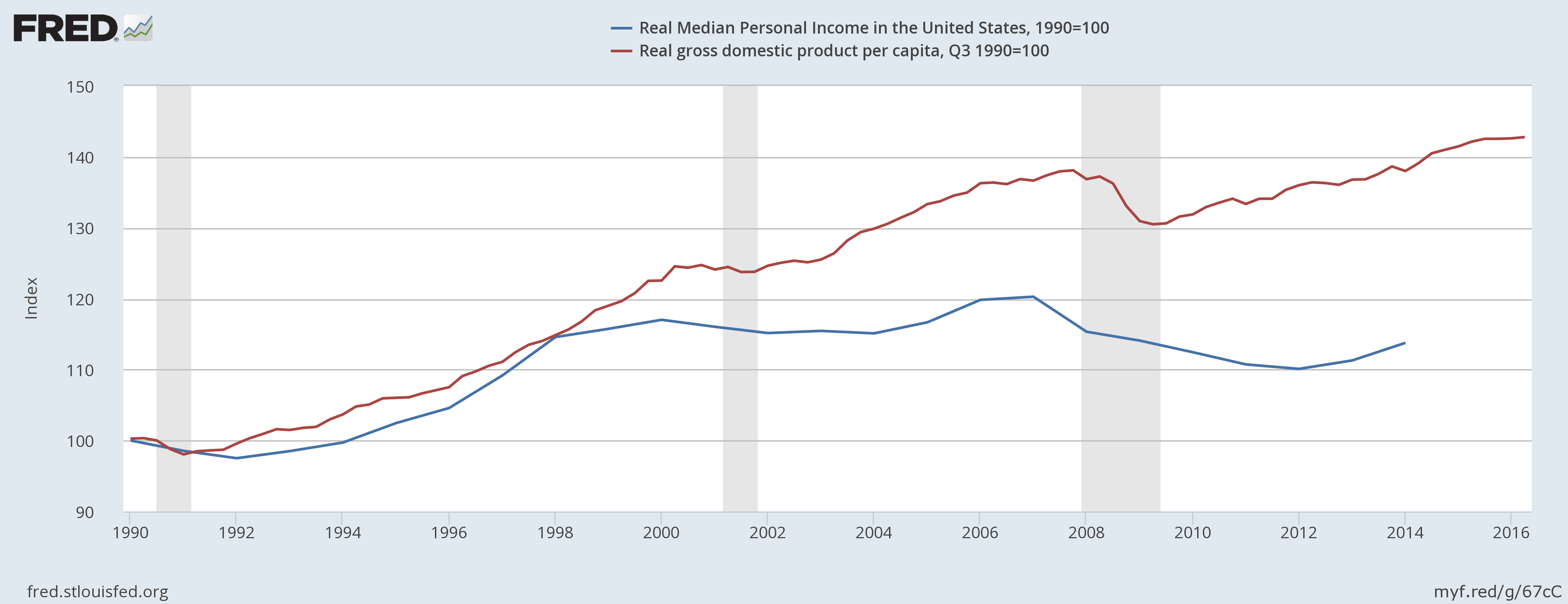


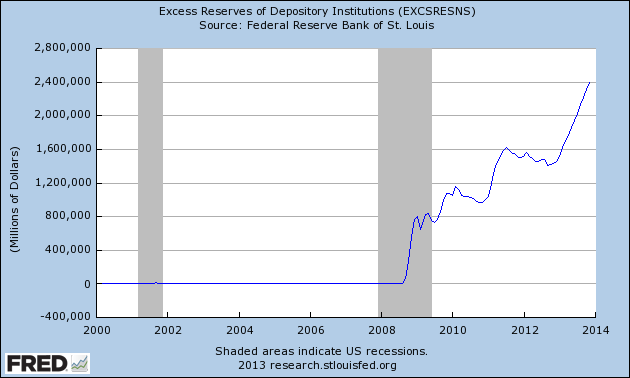

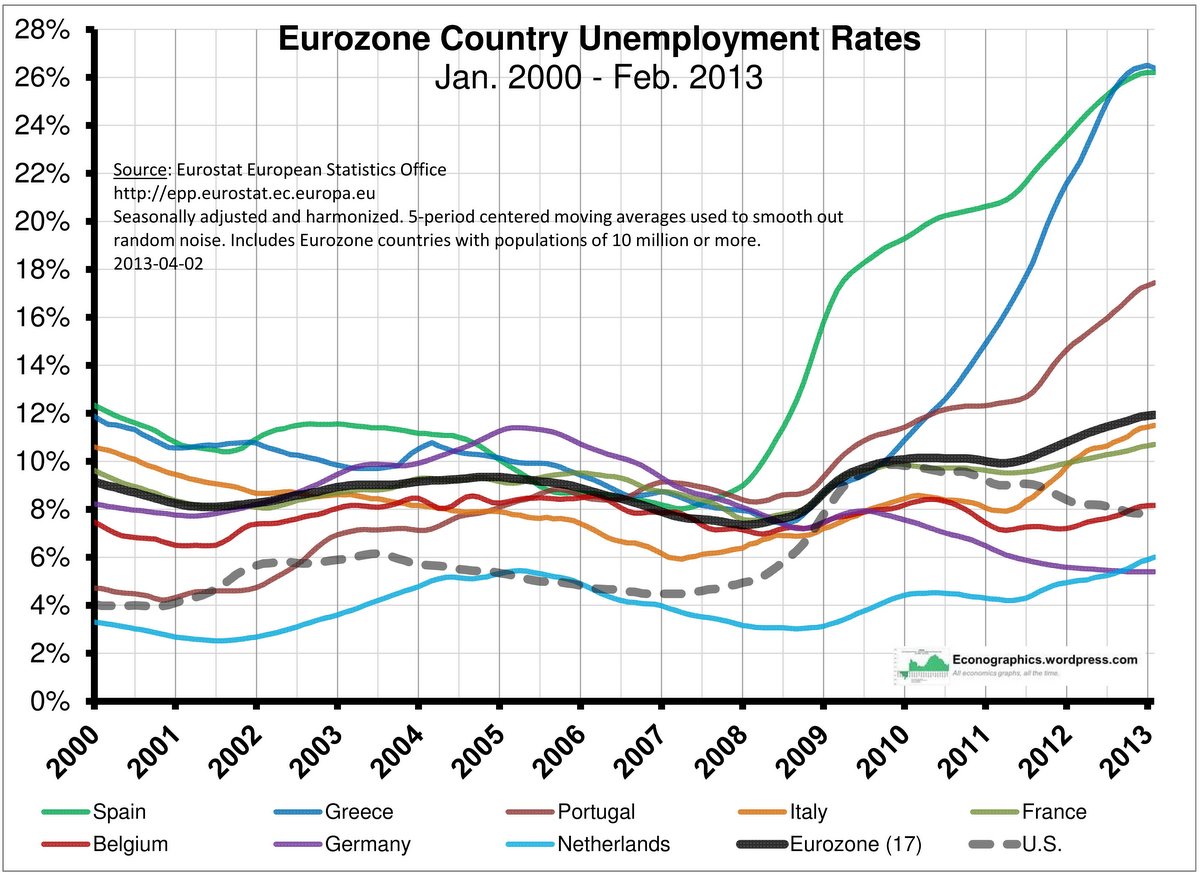


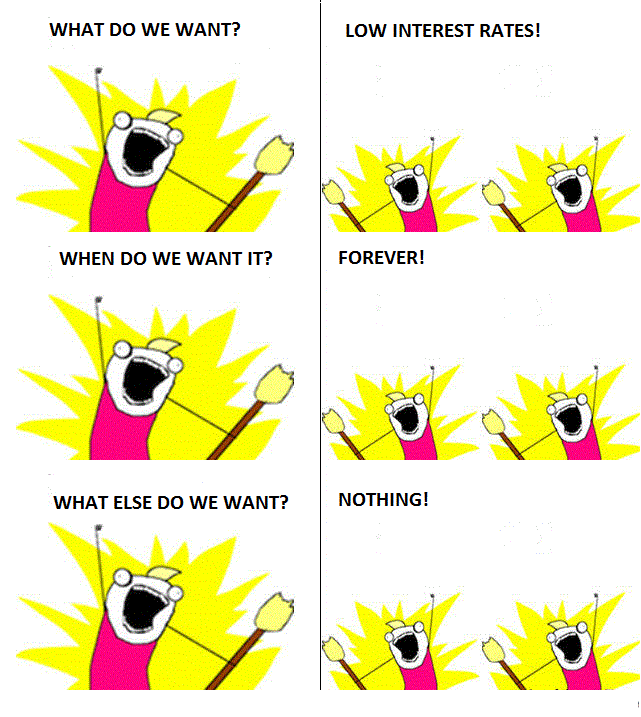


 Blogging Through the Wreckage
